
By Terrence O'Hanlon, Creator, Uptime® Elements | For the Association of Asset Management Professionals
You passed the exam. You know what the Ca tile stands for, you can recite the risk formula, and you have probably seen a criticality ranking or two in your career. So this article is not going to explain criticality analysis to you.
It is going to ask a harder question: why do so many criticality rankings, built by people who know exactly what they are doing, end up as tabs in a spreadsheet that nobody opens?
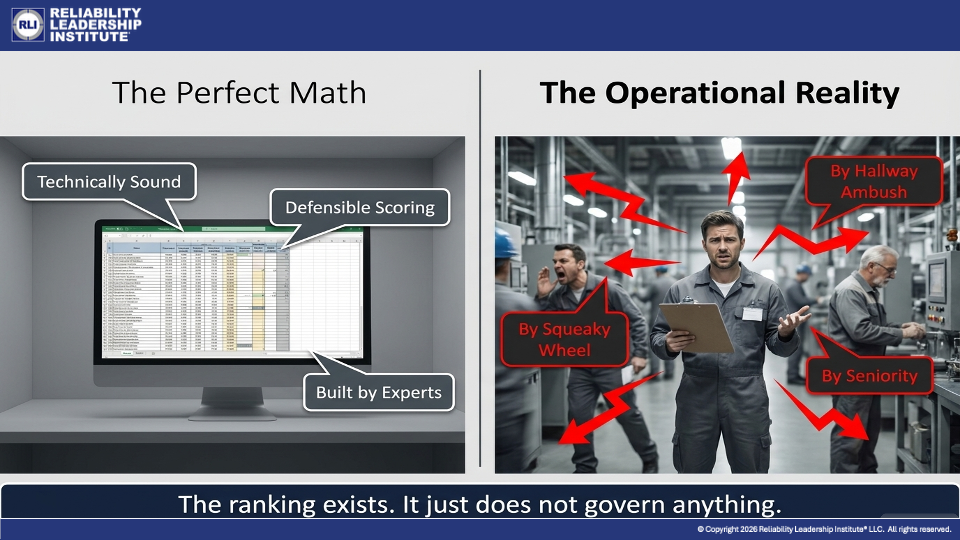
I have watched it happen at world-class sites. The analysis was technically sound. The scoring was defensible. And within a quarter, the plant was scheduling work the way it always had — by squeaky wheel, by seniority, by whoever caught the maintenance manager in the hallway. The ranking existed. It just did not govern anything.
The difference between a ranking that governs and a ranking that gathers dust is not the math. It is everything the Uptime® Elements framework wraps around the math. That is the case for doing criticality analysis the Uptime Elements way, and as a Certified Reliability Leader, you are the person positioned to make it.
The ranking is a decision, not a document
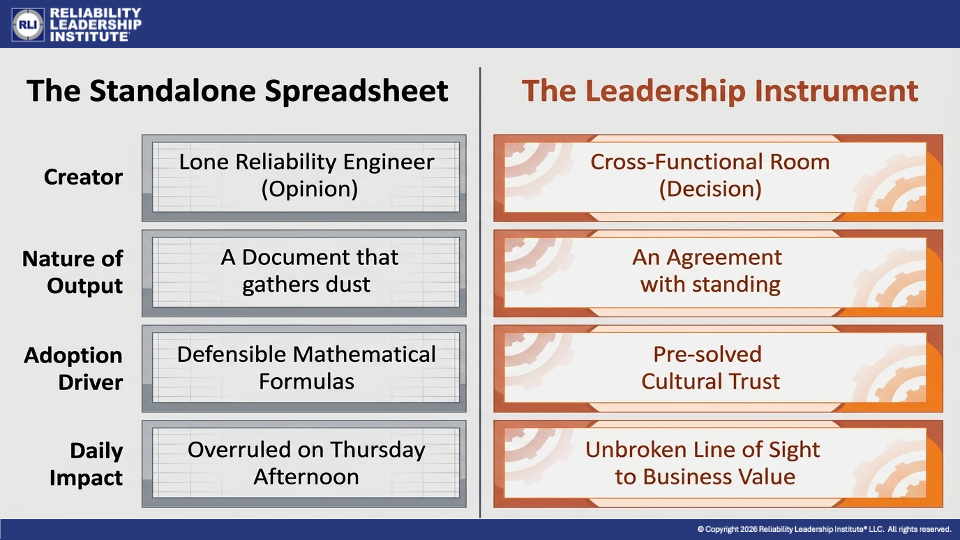
A generic criticality analysis produces a document. An Uptime Elements criticality analysis produces an agreement.
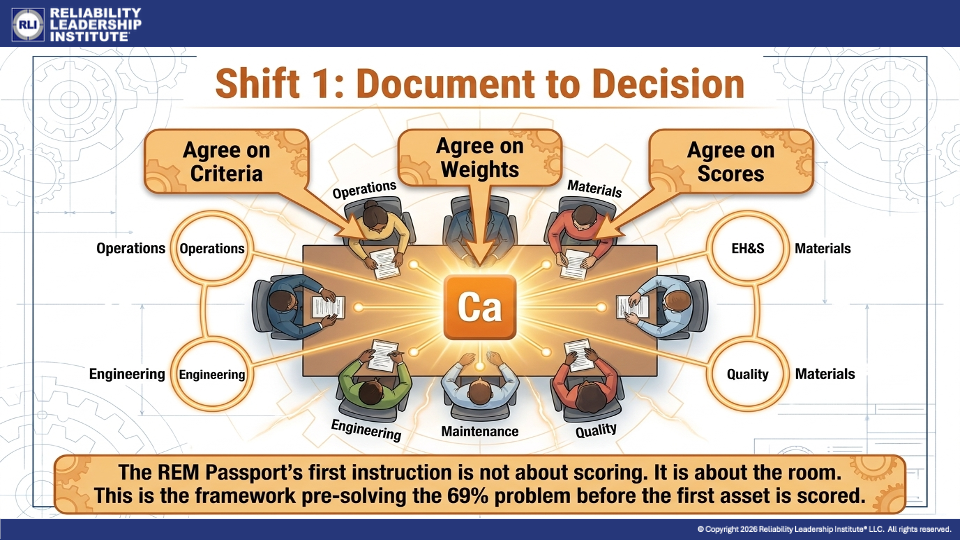
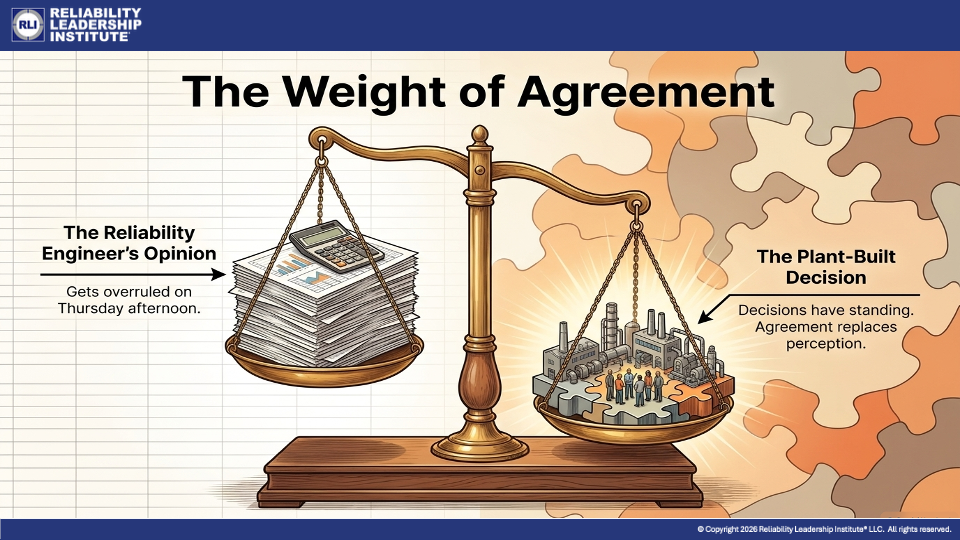
The REM Passport’s first instruction is not about scoring. It is about the room: operations, engineering, maintenance, quality, materials, and EH&S, together, agreeing on the criteria, the weights, and the scores. Agreement replaces individual perceptions. That sentence carries more weight than the formula does, because it changes what the ranking is. A list built by the reliability engineer is the reliability engineer’s opinion, and opinions get overruled on Thursday afternoon. A list the plant built about itself is a decision, and decisions have standing.
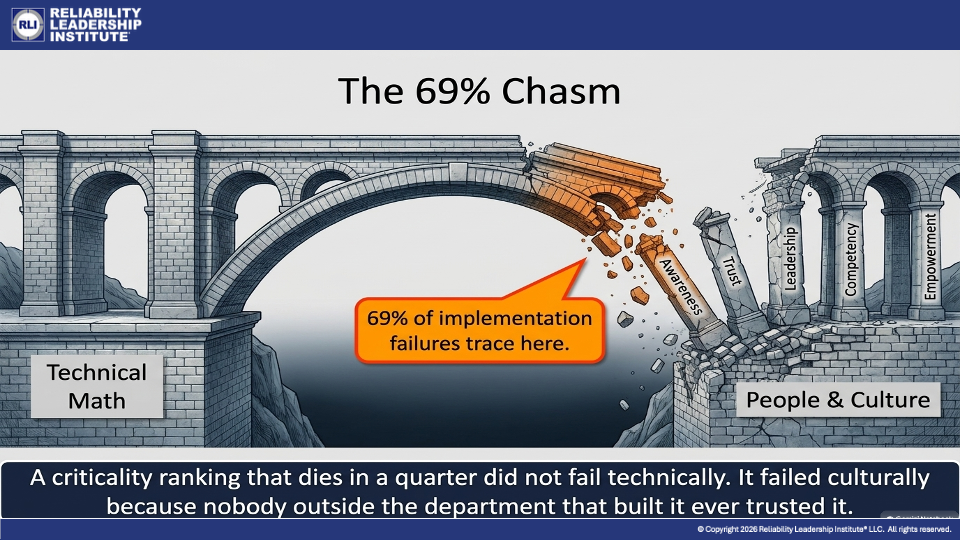
This is where the People and Culture at Work domain stops being an adjacent tile and starts being the mechanism. The framework’s research is blunt: sixty-nine percent of implementation failures trace to people and culture — awareness and trust, leadership, competency, empowerment — not to technical deficiency. A criticality ranking that dies in a quarter did not fail technically. It failed culturally, because nobody outside the department that built it ever trusted it. The cross-functional requirement is not procedural decoration. It is the framework pre-solving the sixty-nine percent problem before the first asset is scored.
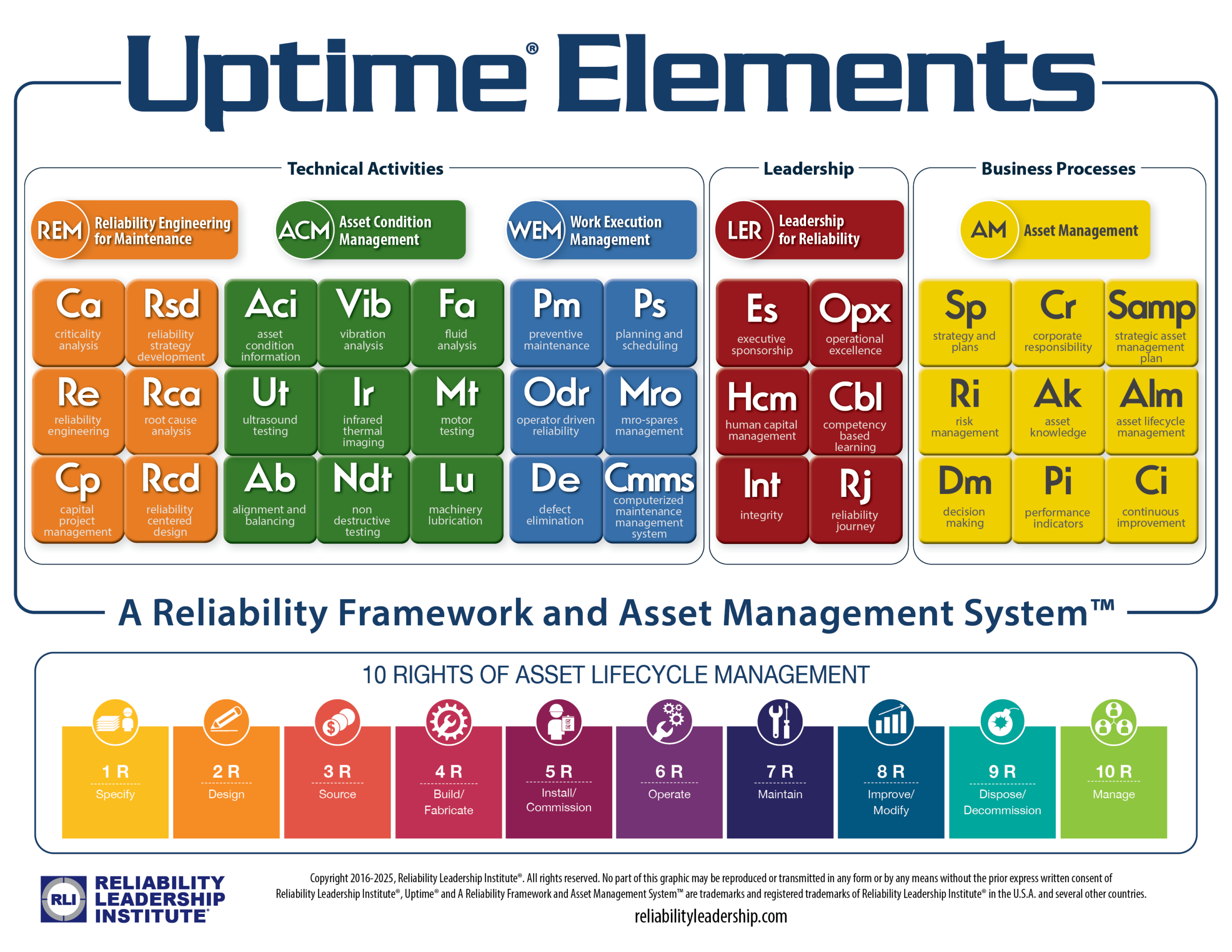
The Uptime® Elements
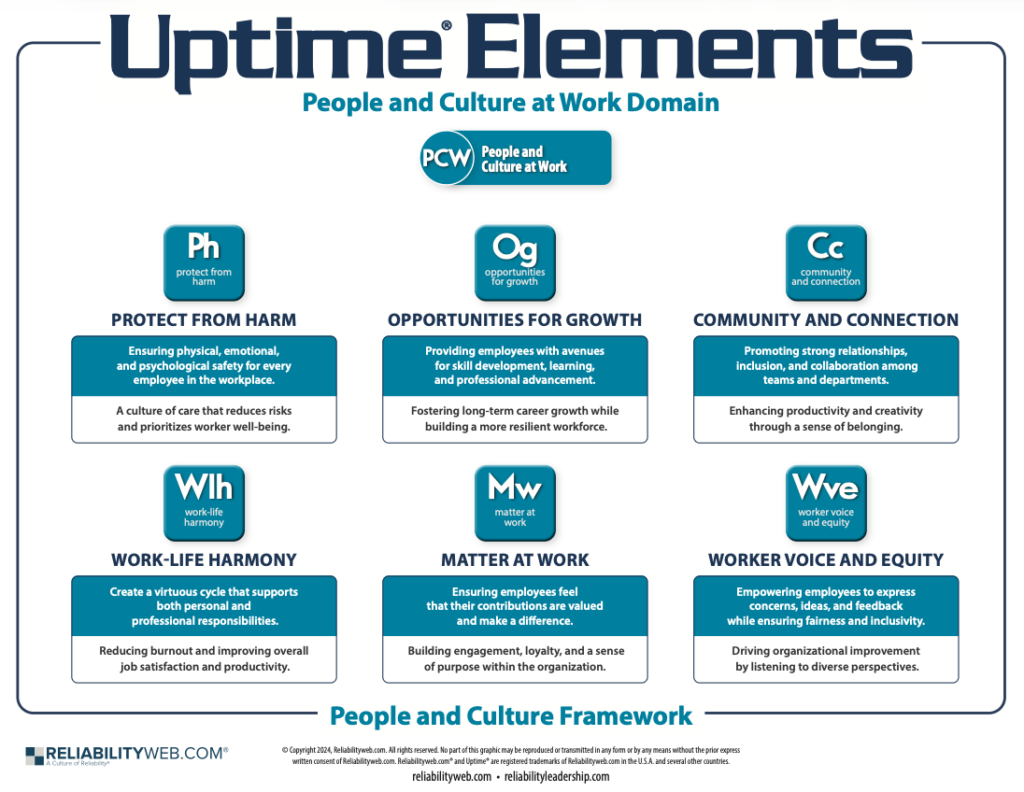
People and Culture Framework
The ranking has somewhere to go
Here is the second thing that separates a framework criticality analysis from an orphaned one: in Uptime Elements, the output has a destination.
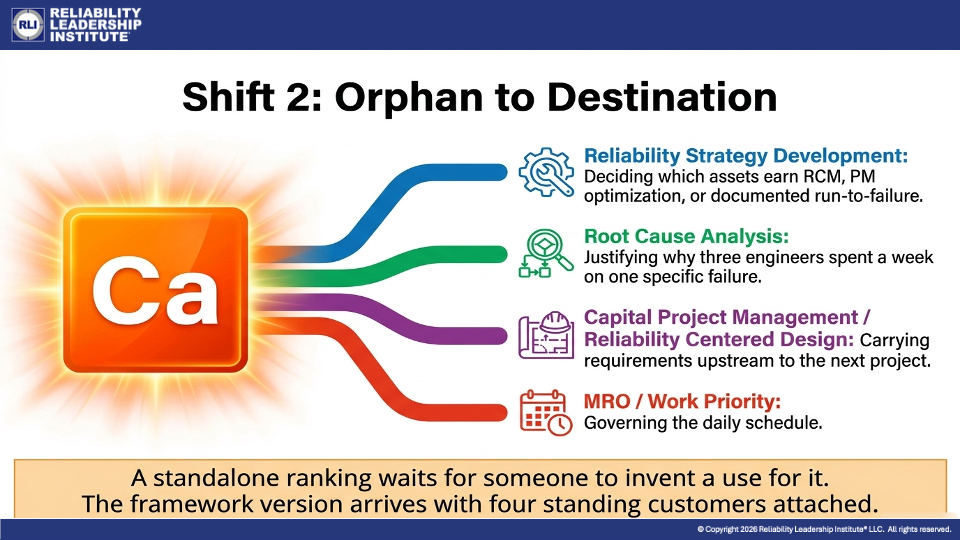
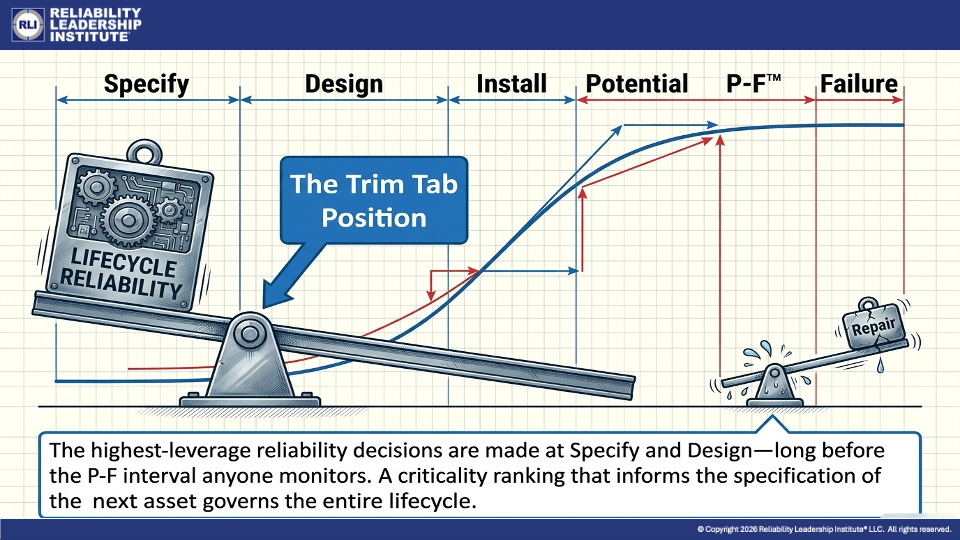
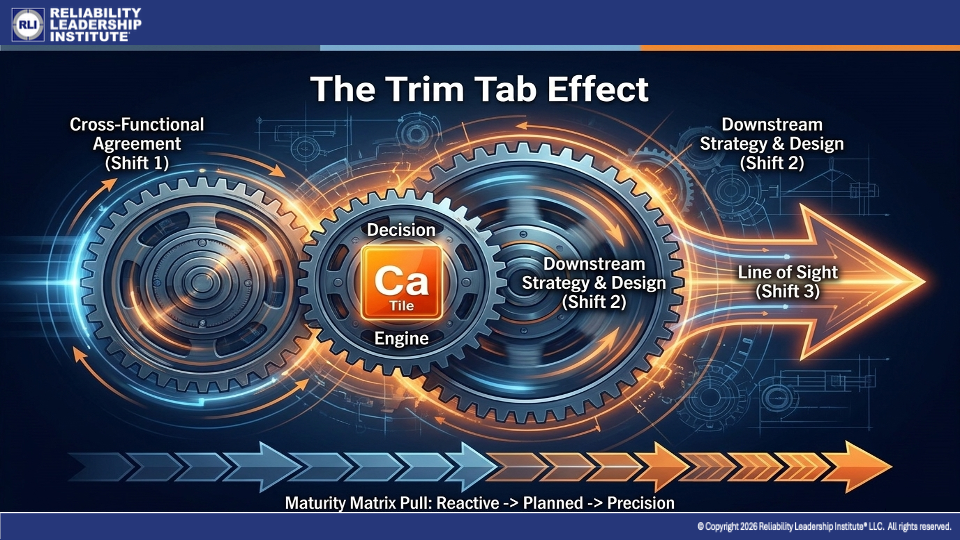
Ca is the first element of the only domain that reduces failures. Everything else in REM consumes what Ca produces. Reliability Strategy Development takes the ranking and decides which assets have earned RCM, which get PM optimization, and which get a deliberate, documented run-to-failure decision. Root Cause Analysis uses it to justify why three engineers spent a week on one failure. Capital Project Management and Reliability Centered Design carry it upstream to the next project — which matters more than most rankings ever acknowledge, because the S-D-I-P-F™ curve tells us the highest-leverage reliability decisions are made at Specify and Design, long before the P-F interval anyone monitors. A criticality ranking that informs the specification of the next critical asset is operating at the Trim Tab position of the entire lifecycle.
A standalone ranking has none of this. It answers “which assets matter” and then waits for someone to invent a use for the answer. The framework version arrives with its uses attached: work priority, strategy development, resource justification, capital and MRO decisions. The Passport names all four. When the output has four standing customers, it does not gather dust.
The ranking creates line of sight
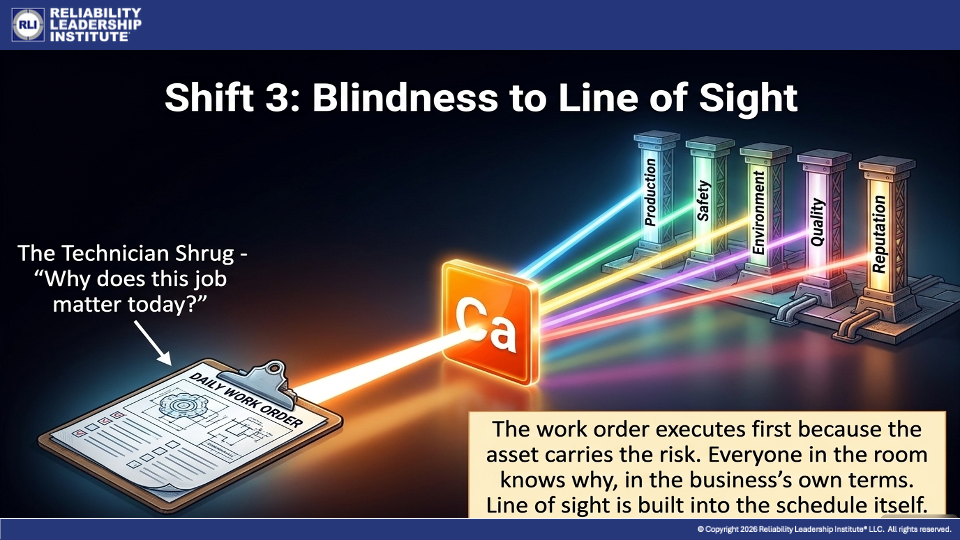
There is a third argument, and for leaders it may be the strongest. AIM — line of sight — is the framework’s demand that daily work connect visibly to organizational purpose. Most maintenance backlogs fail that test. Ask a technician why today’s work order matters to the business and the honest answer, at most sites, is a shrug.
A criticality ranking the plant agreed to changes the answer. The work order executes first because the asset carries the risk, and everyone in the room in step one knows why the asset carries the risk, in the business’s own terms: production, safety, environment, quality, reputation. That is line of sight built into the schedule itself. It is also the difference between a Reactive organization and a Planned one on the Uptime Elements Maturity Matrix — and holding a criticality-governed schedule steady through daily pressure is much of what the climb toward Precision actually consists of.
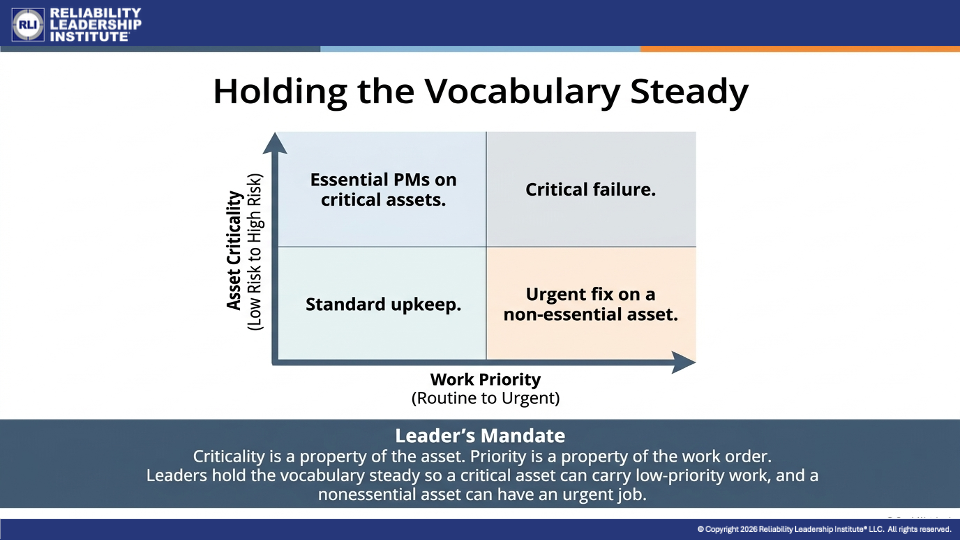
One discipline to guard as you lead this: criticality is a property of the asset; priority is a property of the work order. A critical asset can carry low-priority work; a nonessential asset can have an urgent job. The Competency Based Learning element names confusing the two as a gap. Leaders hold the vocabulary steady so the ranking and the schedule can both be right at once.
Your 30-day activation
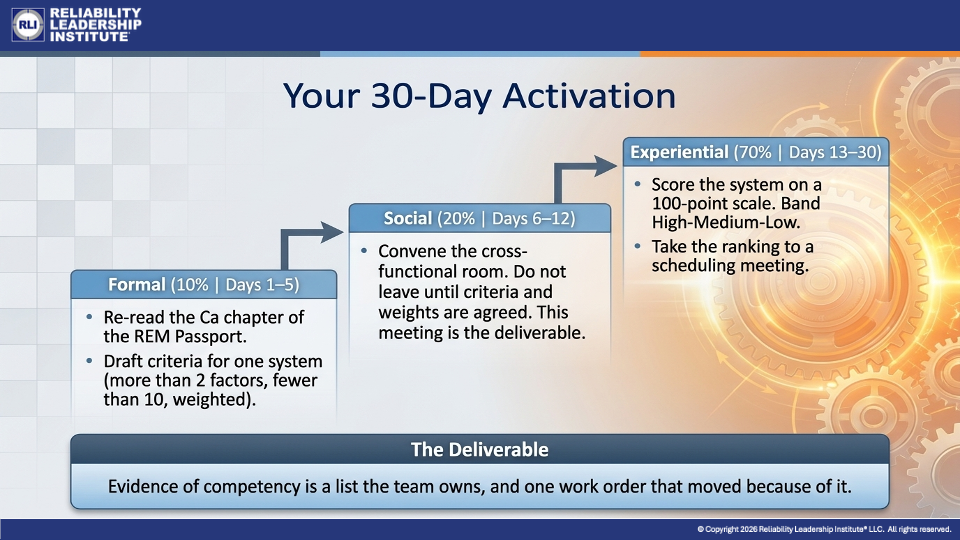
The CRL credential says you know this. The portfolio you are building — toward domain badges and black belt projects — asks you to show it. Here is thirty days of evidence, weighted 10-20-70.
Formal (10% — days 1–5): Re-read the Ca chapter of the REM Passport. Draft criteria for one system: more than two factors, fewer than ten, weighted.
Social (20% — days 6–12): Convene the cross-functional room. Do not leave until criteria and weights are agreed. This meeting is the deliverable.
Experiential (70% — days 13–30): Score the system. Convert to the 100-point scale, band High-Medium-Low, and take the ranking to a scheduling meeting. Evidence of competency: a list the team owns, and one work order that moved because of it.
The framework does not ask you to rank assets because ranking is tidy. It asks because until the plant agrees on what matters, every reliability decision is a guess with good intentions — and reliability leaders do not manage by guess.
Know. Be. Do. And create a future that was not going to happen anyway.
Uptime® Elements — A Reliability Framework and Asset Management System™, S-D-I-P-F™, and Reliability Leadership Institute® are trademarks of Reliability Leadership Institute LLC. The Association of Asset Management Professionals licenses Uptime® Elements for certification examinations, domain badges, and black belt projects.
© 2026 Reliability Leadership Institute® | Terrence O’Hanlon | www.reliabilityleadership.org