
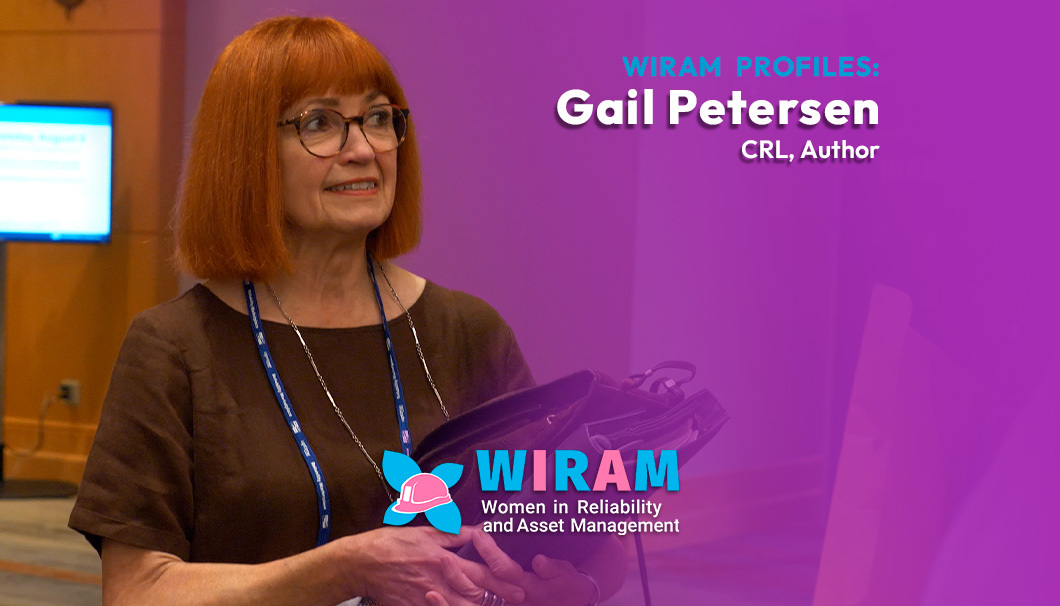
In this interview, Gail Petersen, a renowned industrial strategist and consultant, discusses the impact of leadership, the importance of technical skills, and the transformative role of organizations like Women in Reliability and Asset Management (WIRAM) in opening up new opportunities for more women in the industry.
Asset management is characterized by its strategic focus and the ability to bring all the pieces together to achieve sustainable success over time. Gail Petersen is one of the most respected figures in asset management, specializing in industrial strategies, operational excellence, digital technologies, and ISO 55000 standards. She is also a renowned author and founder of Fortig, Inc., a company whose mission is to accelerate asset performance to help organizations maximize the utilization of their assets and move toward compliance with the ISO 55000 standard.
With her vast experience as a consultant in our industry, Gail is the central figure in our Profiles section, sharing some of her insights on leadership, the role of women in asset management, and the transformative power of AI. Gail is also a Certified Reliability Leader and has shown her support for Women in Reliability and Asset Management (WIRAM) by speaking at various seminars and conferences.
1. Gail, you are a renowned professional, author of several books, speaker… Founder and asset management specialist at Fortig Inc. since 2015. Tell us what you’re currently working on and the challenges you’re passionate about tackling within the profession.
GP: I’m currently working on my memoir that is a comment upon my father’s influence on me and my quest to be a subject matter expert in maintenance, reliability, and asset management. My affiliation with WIRAM represents an important relationship with Maura Abad, WIRAM’s founder, and young women who seek to contribute to this macho dominated community.
2. As a consultant, how do you think our industry will continue to evolve over the next five years and which trends do you believe are here to stay?
GP: How will our industry continue to evolve over the next five years? I have no idea, but I do know that change is constant and the speed of change is accelerating. A significant trend that is here to stay is Artificial Intelligence. This trend is active today and will gain significance as we make use of it and AI increasingly influences our lives. Government policy at every level is required to ensure that AI benefits all, rather than a wealthy few.
3. What must an asset management strategy include to be successful and deliver sustainable results over time?
GP: An asset management strategy must include an Operational Excellence playbook with key measures that have to be met to move the asset-intensive organization from where it is today to the CEO’s and C-Suite’s vision of where they want their organization to be in the future. To be successful, each strategic measure must be owned by someone in the organization to ensure the strategic meas
4. What do you think are the characteristics of a true leader in the asset management field? What are the attitudes and knowledge that distinguish a trusted leader from a manager, for example?
GP: Leadership is a complex endeavor that requires many skills. The characteristics of a true leader in the asset management field are:
- A visionary with a clear Call to Action
- The ability to communicate top-to-shop and engage everyone in the organization so that they contribute to the organization’s success
- A good listener who is able to incorporate good ideas that he / she has heard, then modify their approach accordingly
Above all, a leader must have integrity to be trusted. Employees never know where their leader may take them which is why they must trust their leader. The mind of a manager differs significantly from the soul of a leader. A manager defends their territory rather than contribute to a leader’s vision of their organization.
5. Technical skills are already part of the most sought-after professional profiles. What do you recommend companies do to bridge the technological gap among their employees, from an asset management perspective?
GP: To bridge the technological gap among employees of an asset-intensive organization, it must:
- Determine the degree of risk it is willing to tolerate
- Set the standard for the organization’s technical skills
- Assess each employee for their technical skill
- Conduct learning sessions to bring all employees up to the organization’s standard for technical skills
- Continuously cycle through the above four activities each year
6. What advice would you give to young professionals starting out in maintenance, reliability, and asset management? And I’d like to hear your recommendations, especially for the next generation of young women who want to pursue a career in asset management.
GP: I would advise young professionals starting out in maintenance, reliability, and asset management to learn as much as possible from employees in other organizations: competitors, non-competitors, including supply chain organizations, and regulatory agencies. For the next generation of young women who want to pursue a career in asset management, I recommend that they join WIRAM, engage in life-long learning, and have the courage to pursue their passion.