
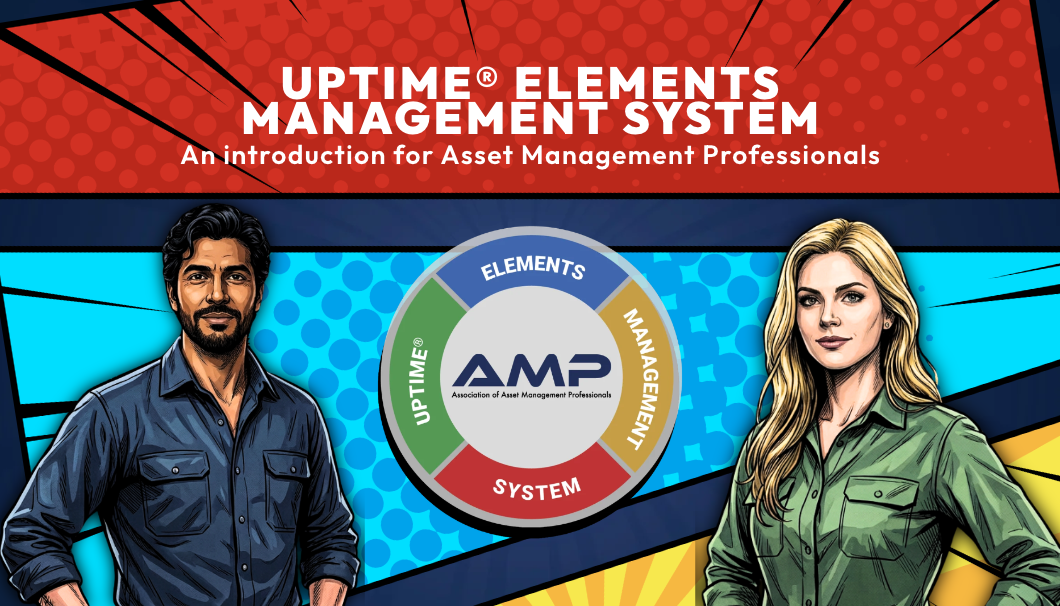
A 101 guide for members of the Association of Asset Management Professionals (AMP) By Terrence O'Hanlon, Creator, Uptime® Elements
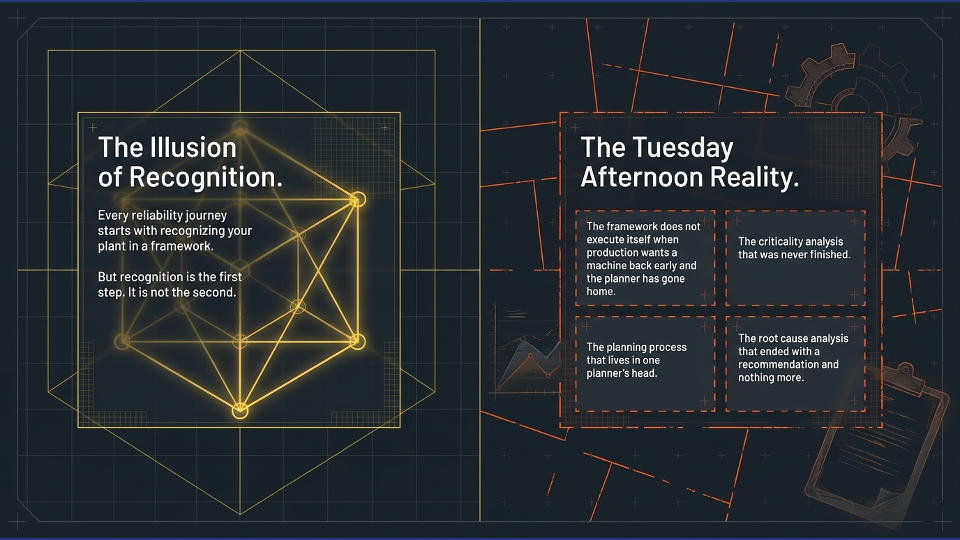
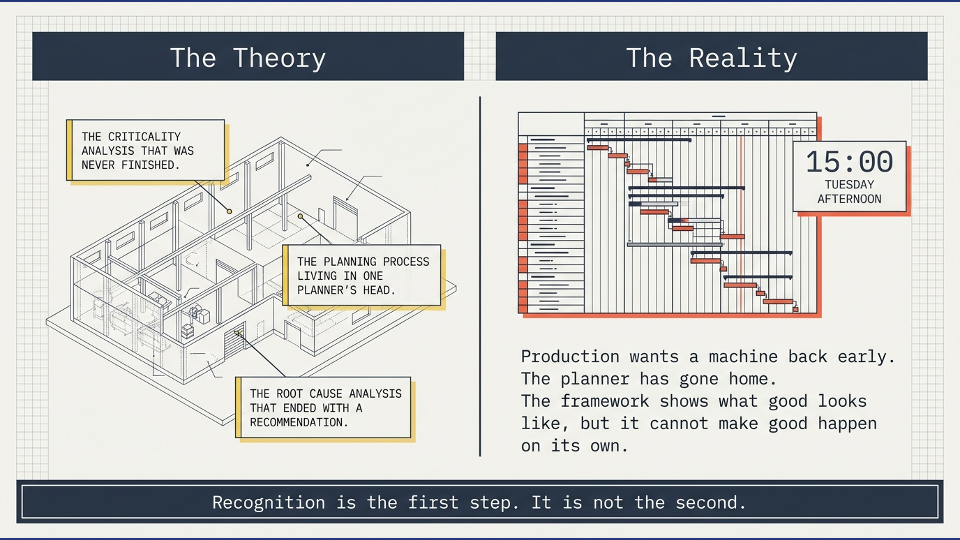
Every reliability journey starts the same way. Someone sees Uptime® Elements — A Reliability Framework and Asset Management System™ for the first time and recognizes their own plant in it. The criticality analysis that was never finished. The planning process that lives in one planner’s head. The root cause analysis that ended with a recommendation and nothing more.
Recognition is the first step. It is not the second.
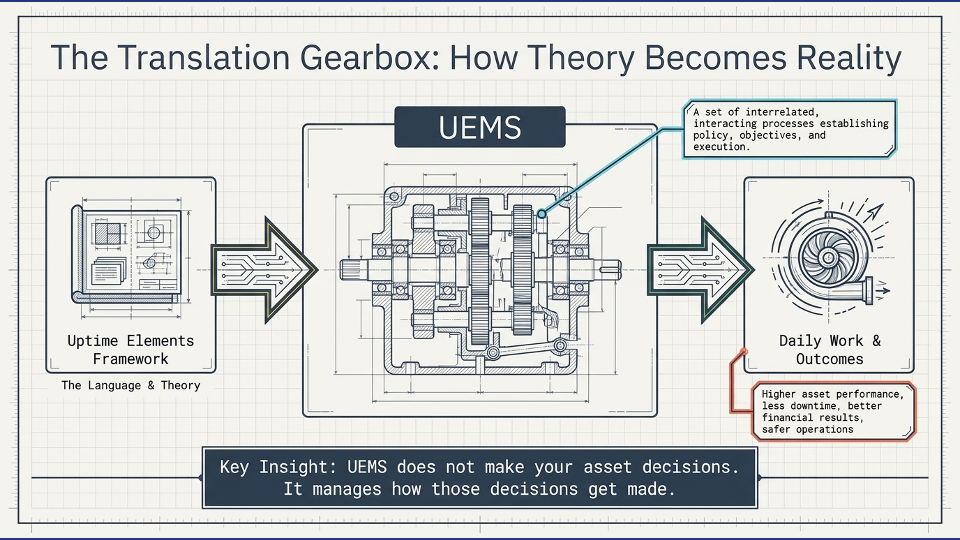
The framework shows what good looks like. It does not, by itself, make good happen on a Tuesday afternoon when production wants a machine back early and the planner has gone home. That is the work of a management system. The Uptime® Elements Management System™ (UEMS) is the management system built to carry the framework into daily work and keep it there.
What the UEMS Is
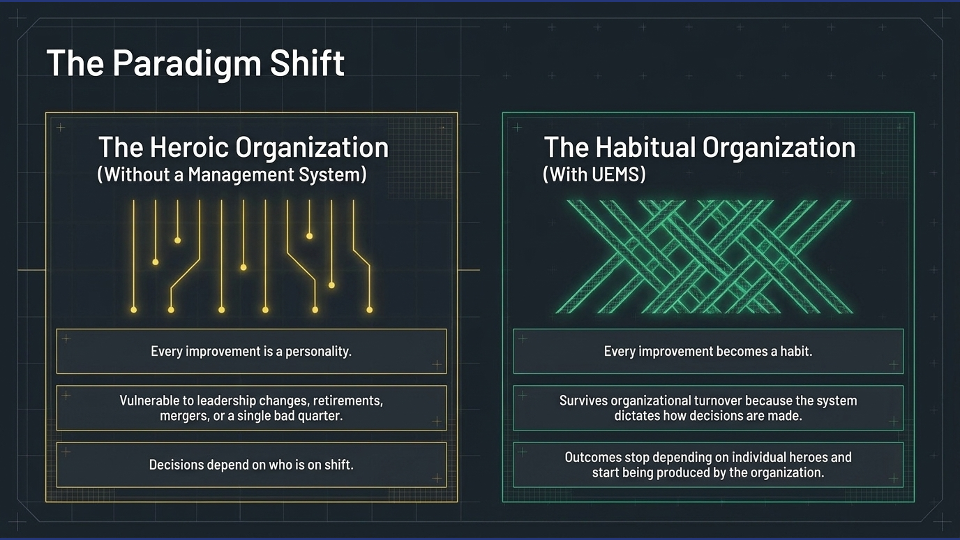
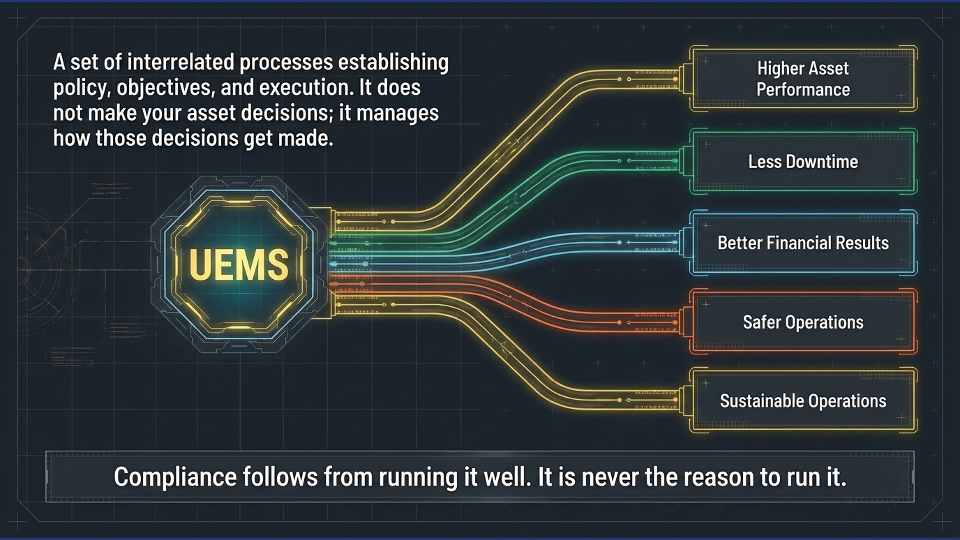
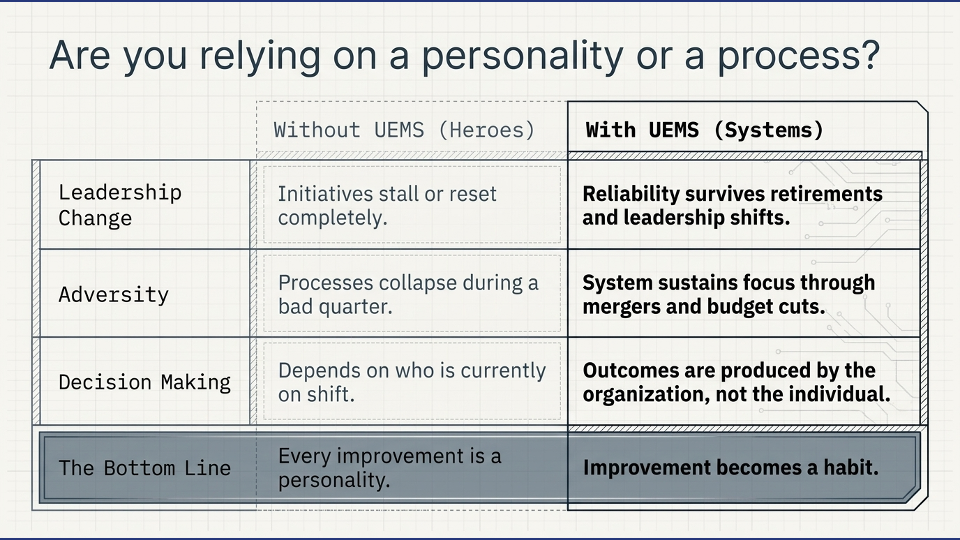
The UEMS is a set of interrelated, interacting processes that establish an organization’s reliability and asset management policy, its objectives, and the processes to achieve them. It does not make your asset decisions. It manages how those decisions get made, so good outcomes stop depending on individual heroes and start being produced by the organization.
That is how reliability survives a leadership change, a retirement, a merger, or a bad quarter. Without a management system, every improvement is a personality. With one, improvement becomes a habit.
The UEMS is centered on business outcomes: higher asset performance, less downtime, better financial results, safer and more sustainable operations. Compliance follows from running it well. It is never the reason to run it. The framework behind it has been implemented at more than 6,000 locations and is practiced by more than 4,000 Certified Reliability Leaders worldwide. The UEMS is how those organizations turn a shared language into a shared way of working.
Four Themes That Run Through Everything
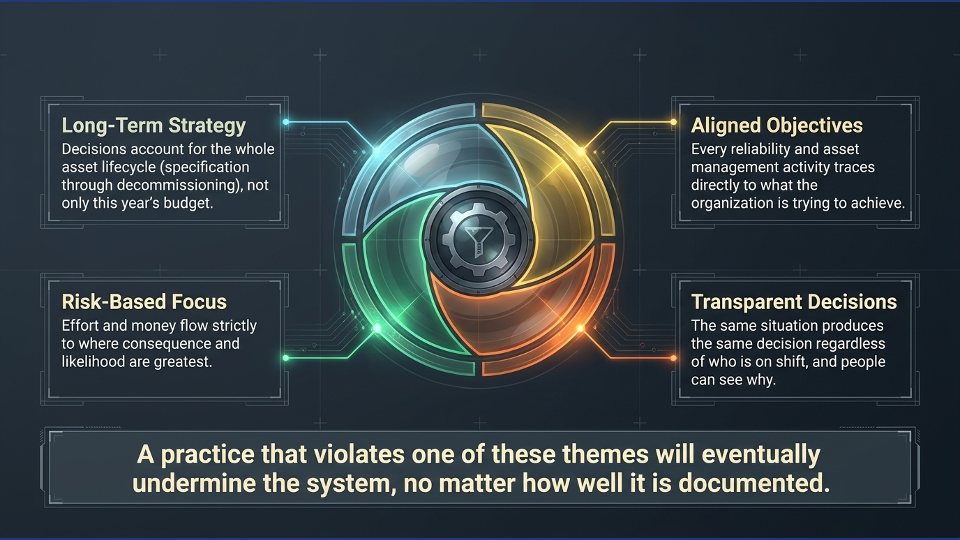
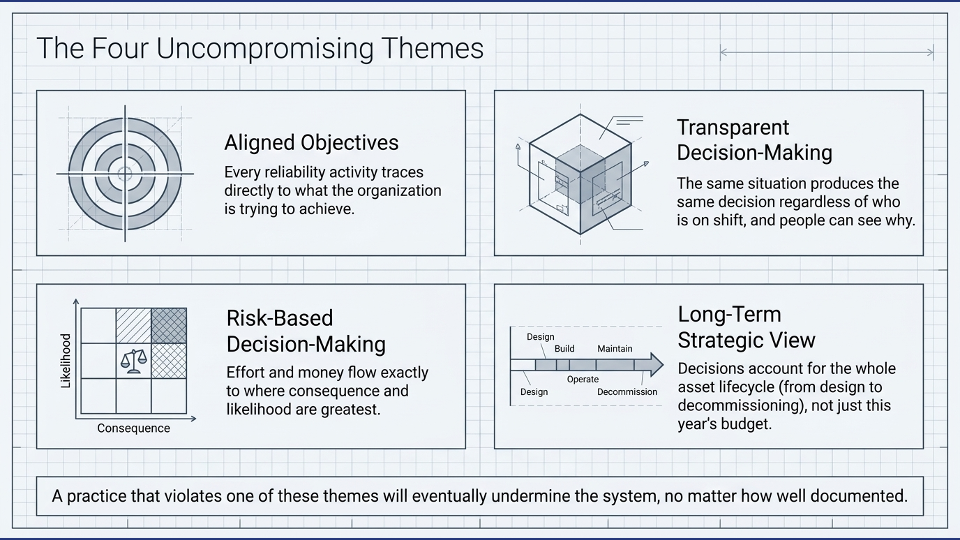
Four themes thread through every UEMS requirement. Hold your current practices up against them before you begin.
Aligned objectives — every reliability and asset management activity traces to what the organization is trying to achieve. Transparent and consistent decision-making — the same situation produces the same decision regardless of who is on shift, and people can see why. Risk-based decision-making — effort and money flow to where consequence and likelihood are greatest. A long-term strategic view — decisions account for the whole asset lifecycle, from specification and design through decommissioning, not only this year’s budget.
A practice that violates one of these themes will eventually undermine the system, no matter how well it is documented.
Seven Requirements, One Cycle
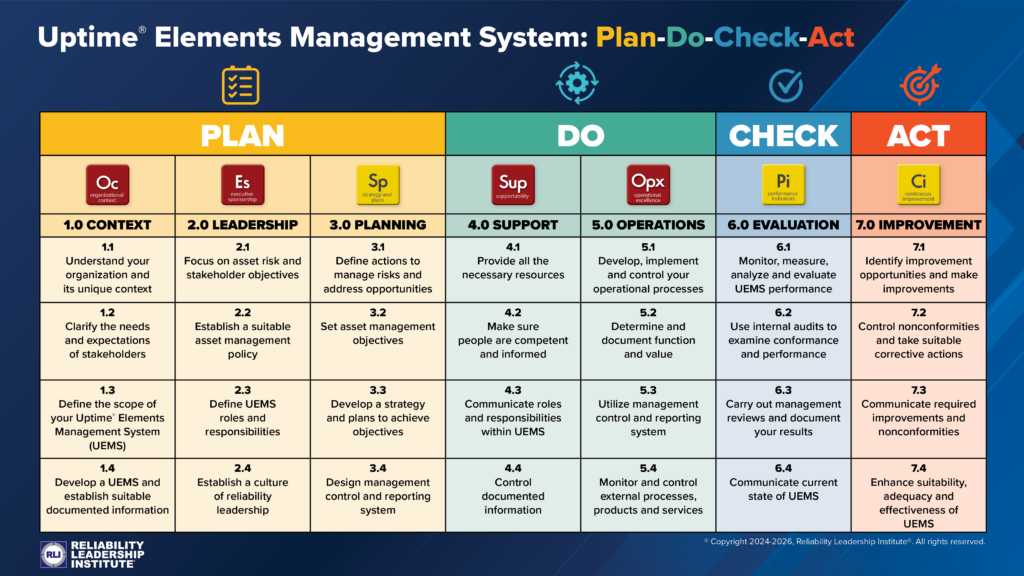
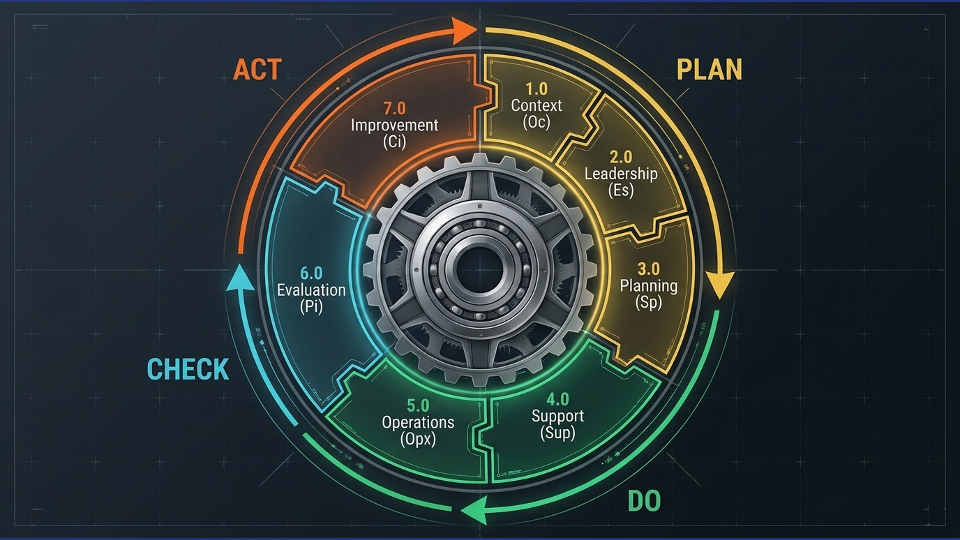
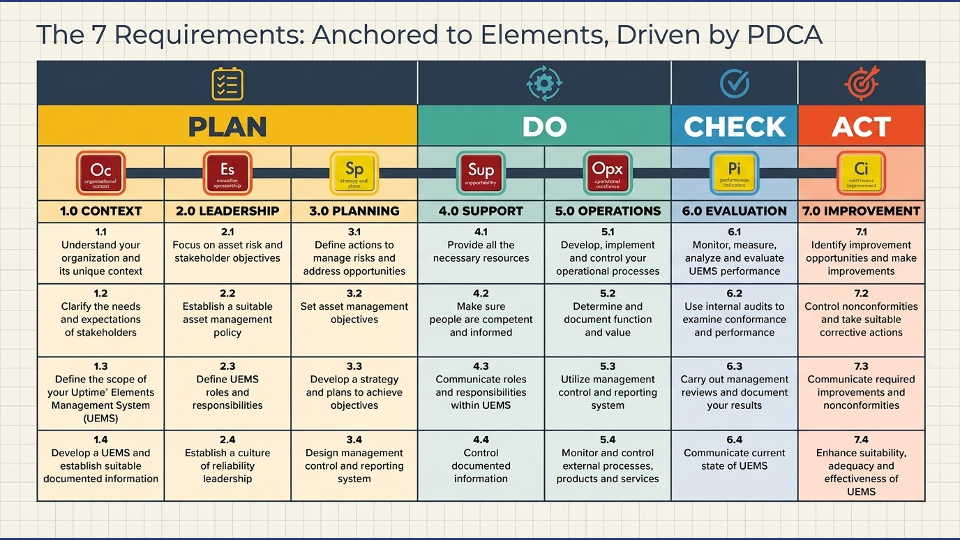
The UEMS is organized into seven requirements. Each is anchored to an Uptime® Elements tile, and together they run the Plan-Do-Check-Act cycle.
- Plan:0 Context (Oc) · 2.0 Leadership (Es) · 3.0 Planning (Sp)
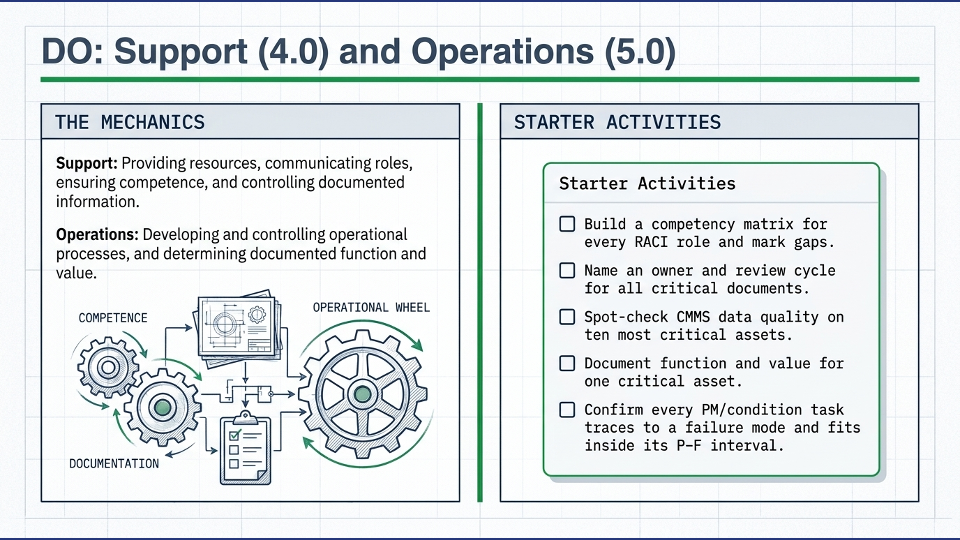
- Do:0 Support (Sup) · 5.0 Operations (Opx)
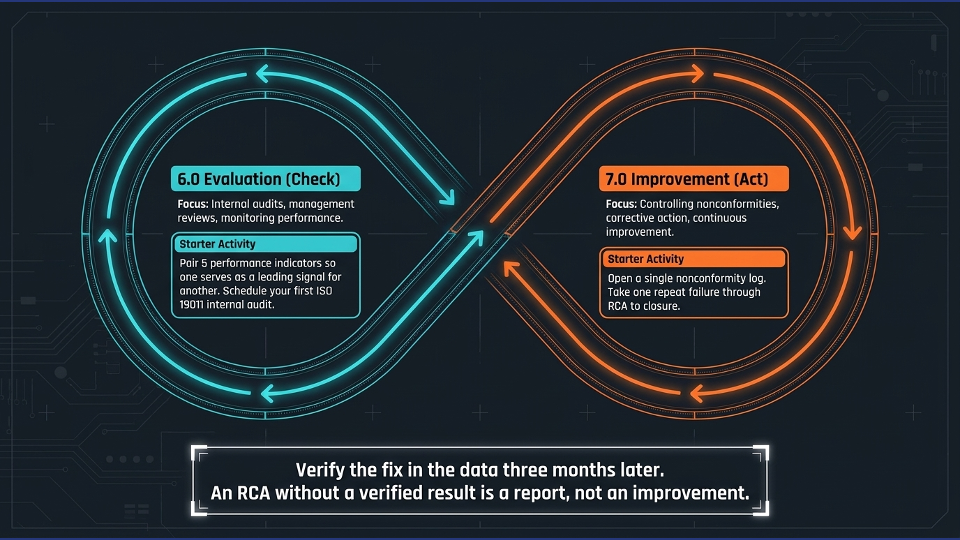
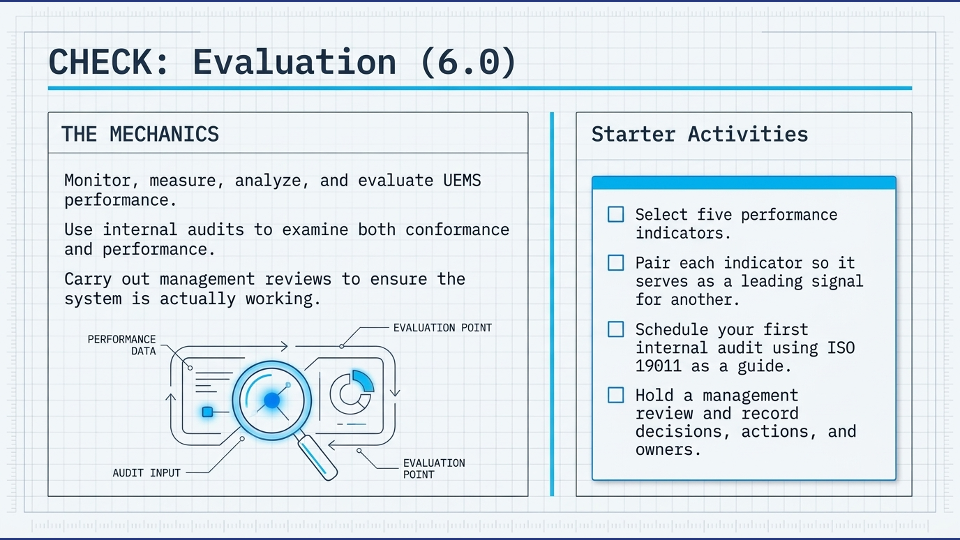
- Check:0 Evaluation (Pi)
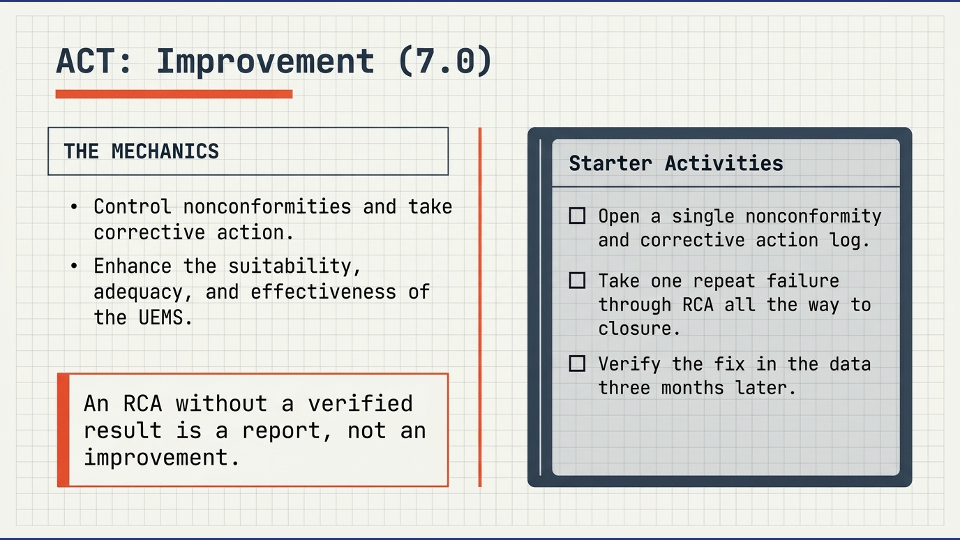
- Act:0 Improvement (Ci)
Each requirement has four sub-requirements. The sections below step through them with the Body of Knowledge elements that do the work and one starter activity for each.
1.0 Context — Organizational Context (Oc)
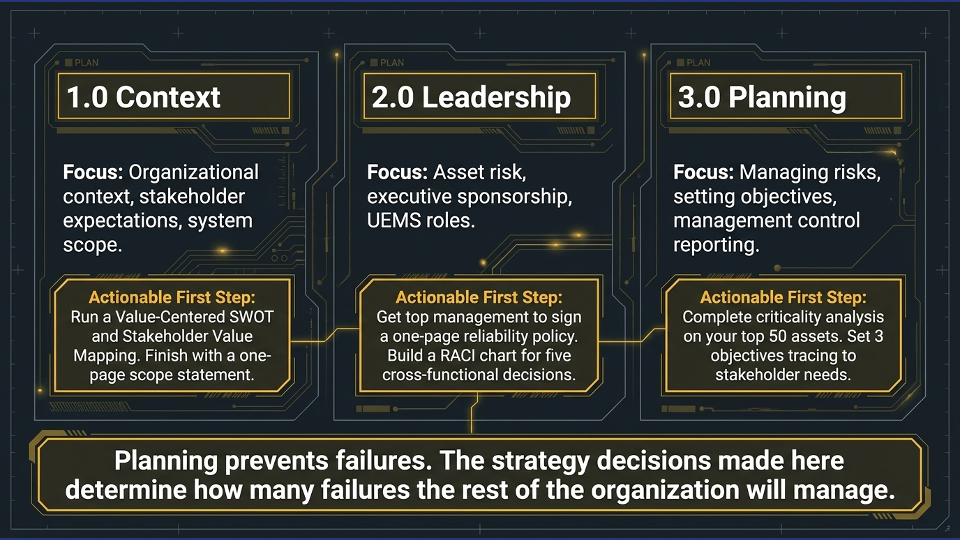
Understand your organization and its unique context (1.1), clarify the needs and expectations of stakeholders (1.2), define the scope of your UEMS (1.3), and develop the UEMS with suitable documented information (1.4). Supporting elements: Executive Sponsorship (Es), Integrity (Int), Corporate Responsibility (Cr), and Strategy and Plans (Sp).
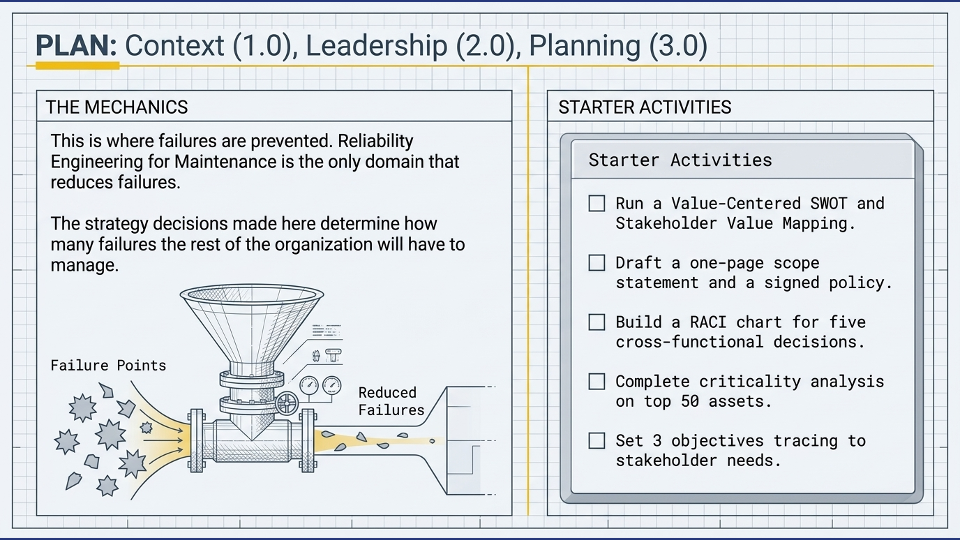
Activity: Run a Value-Centered SWOT for your site, then a Stakeholder Value Mapping exercise that names each stakeholder and what they need from your assets. Finish with a one-page scope statement listing the sites, asset classes, and boundaries the UEMS covers.
2.0 Leadership — Executive Sponsorship (Es)
Focus on asset risk and stakeholder objectives (2.1), establish a suitable asset management policy (2.2), define UEMS roles and responsibilities (2.3), and establish a culture of reliability leadership (2.4). Supporting elements: Reliability Journey (Rj), Strategic Asset Management Plan (Samp), Asset Knowledge (Ak), and Decision Making (Dm). Top management integrates UEMS requirements into business processes, provides resources, communicates why the system matters, and makes sure it achieves its intended outcomes.
Activity: Draft a one-page reliability and asset management policy and get it signed by top management. Then build a RACI chart for five cross-functional decisions, such as releasing a critical asset to maintenance or approving a change to a PM task.
3.0 Planning — Strategy and Plans (Sp)
Define actions to manage risks and address opportunities (3.1), set asset management objectives (3.2), develop a strategy and plans to achieve them (3.3), and design the management control and reporting system (3.4). Supporting elements: Risk Management (Ri), Asset Lifecycle Management (Alm), Criticality Analysis (Ca), Reliability Strategy Development (Rsd), Capital Project Management (Cp), and Reliability Centered Design (Rcd).
This is where failures are prevented. Reliability Engineering for Maintenance is the only domain that reduces failures; the strategy decisions made here determine how many failures the rest of the organization will have to manage.
Activity: Complete a criticality analysis on your top 50 assets. Set three objectives that trace directly to the stakeholder needs from 1.2. Sketch the reporting design: who receives which indicator, how often, and what decision it is meant to drive.
4.0 Support — Supportability (Sup)
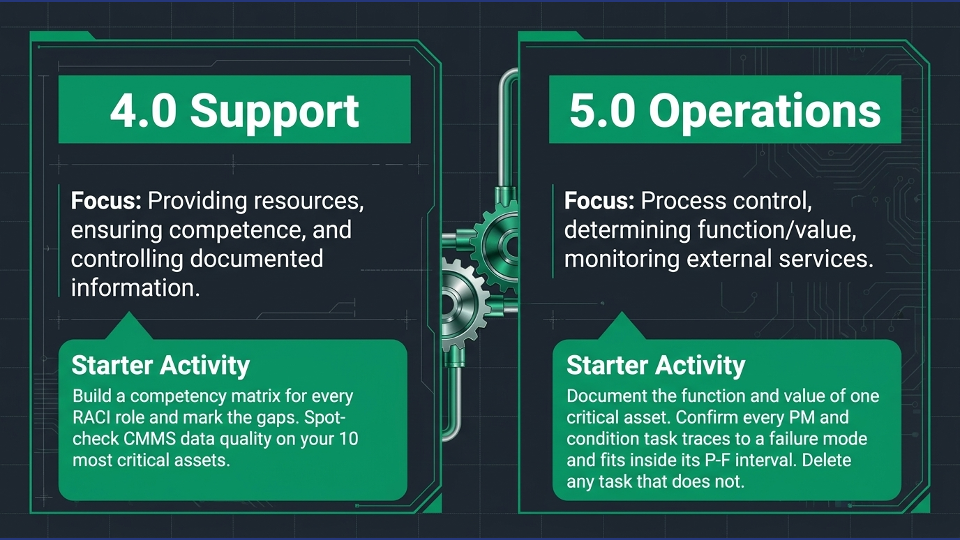
Provide the necessary resources (4.1), make sure people are competent and informed (4.2), communicate roles and responsibilities within the UEMS (4.3), and control documented information (4.4). Supporting elements: Human Capital Management (Hcm), Competency Based Learning (Cbl), MRO-Spares Management (Mro), Computerized Maintenance Management System (Cmms), and Planning and Scheduling (Ps).
Activity: Build a competency matrix for every role named in your RACI and mark the gaps. List the documented information the system depends on — policy, strategies, job plans, asset register — and name an owner and review cycle for each. Spot-check CMMS data quality on your ten most critical assets.
5.0 Operations — Operational Excellence (Opx)
Develop, implement, and control operational processes (5.1), determine and document function and value (5.2), use the management control and reporting system (5.3), and monitor and control external processes, products, and services (5.4). Supporting elements: Preventive Maintenance (Pm), Operator Driven Reliability (Odr), and the asset condition management tiles — Vibration Analysis (Vib), Ultrasound Testing (Ut), Infrared Thermal Imaging (Ir), Motor Testing (Mt), Alignment and Balancing (Ab), Non-Destructive Testing (Ndt), Machinery Lubrication (Lu), and Fluid Analysis (Fa).
Activity: Choose one critical asset. Document its function and the value it delivers. Confirm that every PM and condition monitoring task traces to a specific failure mode and fits inside its P–F interval. Delete or redesign any task that does not. Review how contractors working on that asset are specified, controlled, and verified.
6.0 Evaluation — Performance Indicators (Pi)
Monitor, measure, analyze, and evaluate UEMS performance (6.1), use internal audits to examine conformance and performance (6.2), carry out management reviews and document the results (6.3), and communicate the current state of the UEMS (6.4). Supporting elements: Operational Excellence (Opx), Performance Indicators (Pi), and Asset Condition Information (Aci).
Activity: Select five performance indicators and pair each one so it can serve as a leading signal for another. Schedule your first internal audit using ISO 19011 as the guide. Hold a management review and record its decisions, actions, and owners.
7.0 Improvement — Continuous Improvement (Ci)
Identify improvement opportunities and make improvements (7.1), control nonconformities and take corrective action (7.2), communicate required improvements and nonconformities (7.3), and enhance the suitability, adequacy, and effectiveness of the UEMS (7.4). Supporting elements: Defect Elimination (De), Reliability Engineering (Re), and Root Cause Analysis (Rca).
Activity: Open a single nonconformity and corrective action log. Take one repeat failure through root cause analysis all the way to closure — then verify the fix in the data three months later. An RCA without a verified result is a report, not an improvement.
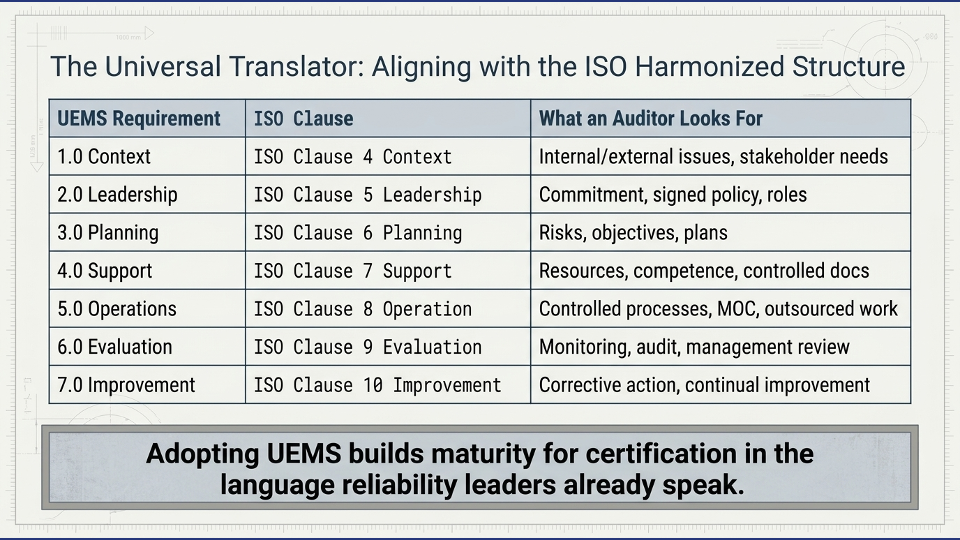
How the UEMS Aligns with the ISO Harmonized Structure
| UEMS Requirement | ISO Clause | What an auditor looks for |
|---|---|---|
|
1.0 Context (Oc) |
4 Context of the organization |
Internal and external issues, stakeholder needs, defined scope |
|
2.0 Leadership (Es) |
5 Leadership |
Top management commitment, signed policy, assigned roles |
|
3.0 Planning (Sp) |
6 Planning |
Risks and opportunities, measurable objectives, plans to achieve them |
|
4.0 Support (Sup) |
7 Support |
Resources, competence, awareness, communication, controlled documents |
|
5.0 Operations (Opx) |
8 Operation |
Controlled processes, management of change, control of outsourced work |
|
6.0 Evaluation (Pi) |
9 Performance evaluation |
Monitoring, internal audit, management review |
|
7.0 Improvement (Ci) |
10 Improvement |
Nonconformity, corrective action, continual improvement |
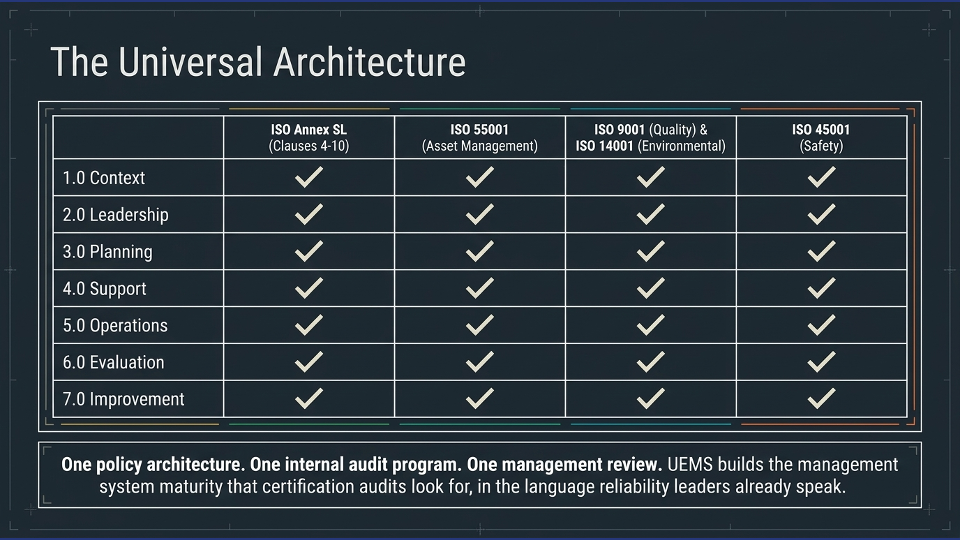
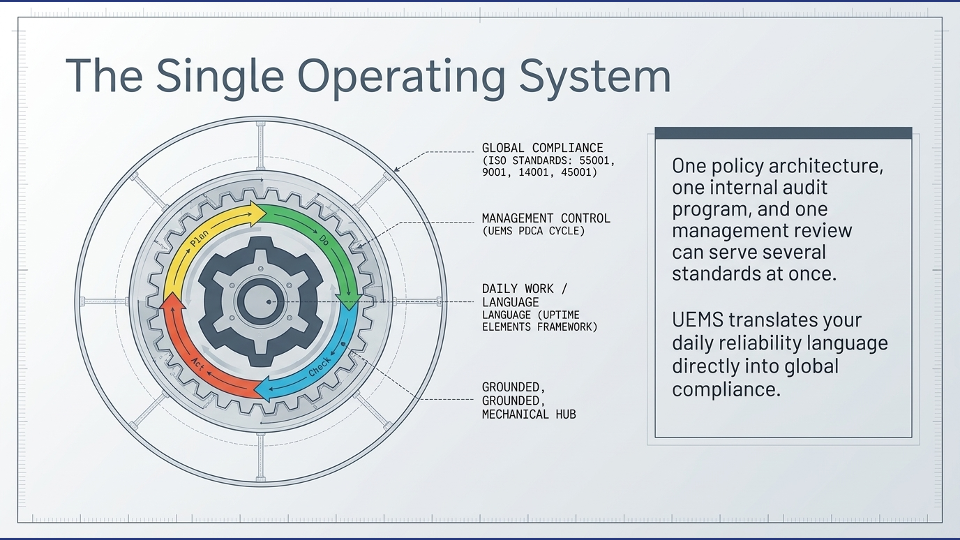
Because the clause logic is shared, the UEMS aligns directly with ISO 55001:2024 (asset management), ISO 9001(quality), and ISO 14001 (environmental management). The same structure carries ISO 45001 (occupational health and safety), ISO 50001 (energy), ISO/IEC 27001 (information security), ISO 22301 (business continuity), and ISO/IEC 42001(artificial intelligence). Guidance standards such as ISO 31000 for risk and IEC 60300-1 for dependability management support the system without adding certifiable requirements.
In practice, that means one policy architecture, one internal audit program, and one management review can serve several standards at once. An organization already certified to ISO 9001 or ISO 14001 will find the UEMS familiar on the first day, and it slots into the existing system instead of competing with it. An organization holding no ISO certification can run the UEMS as a complete, stand-alone management system at any size.
One distinction belongs in every conversation. Adopting the UEMS does not certify an organization to any ISO standard. It builds the management system maturity that certification audits look for, and it does so in the language reliability leaders already speak.
Where to Start
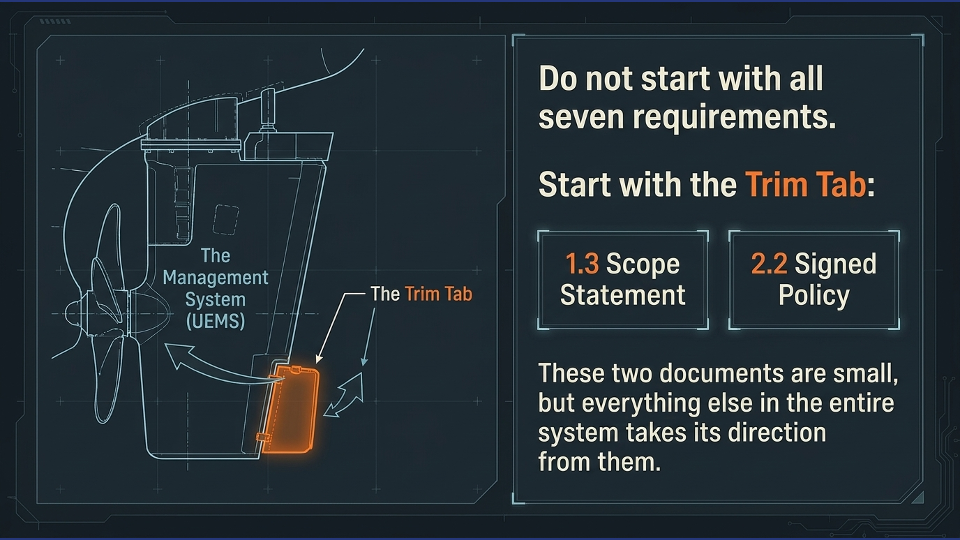
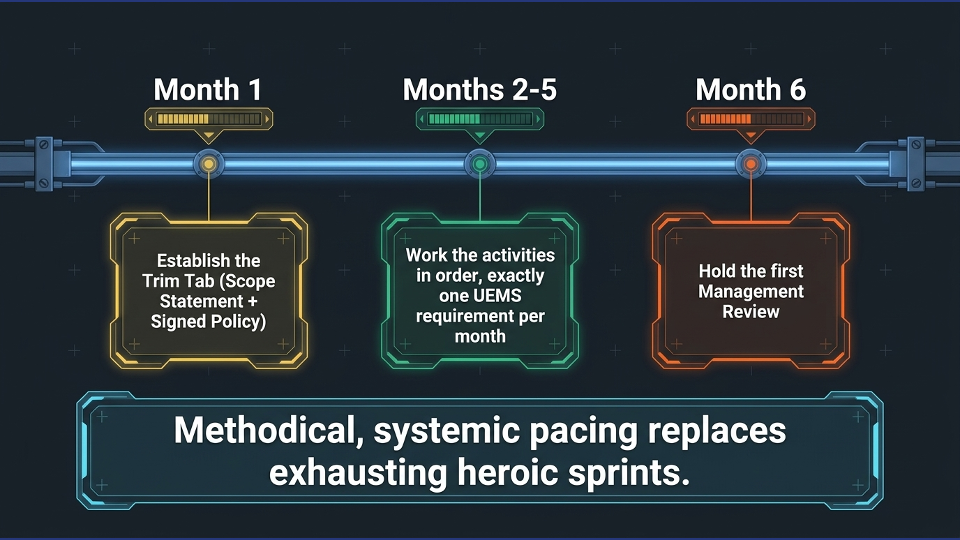
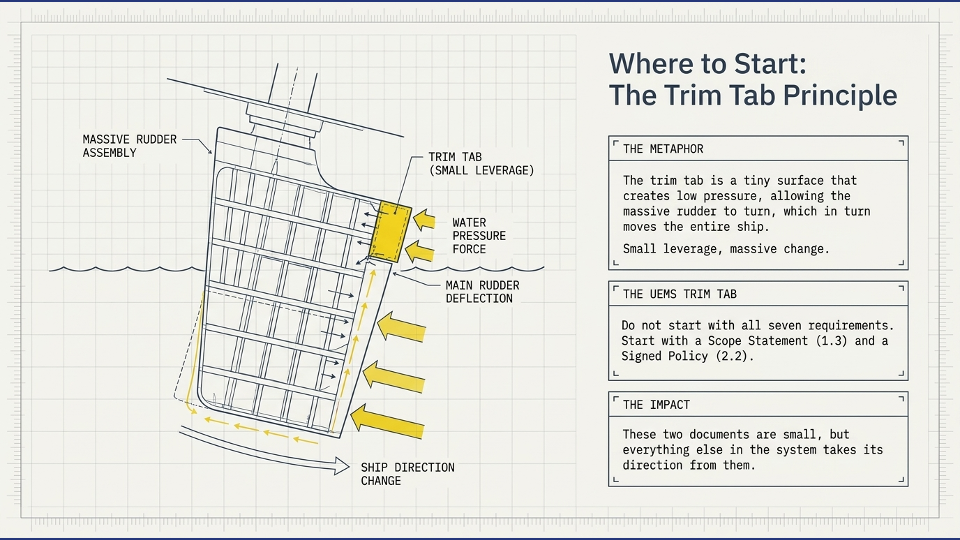
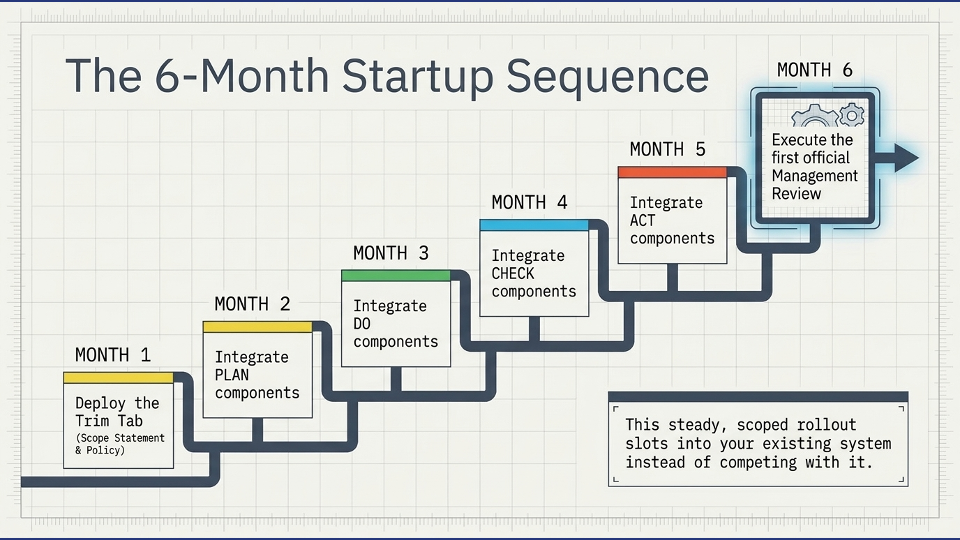
Do not start with all seven requirements. Start with the Trim Tab: a scope statement (1.3) and a signed policy (2.2). Those two documents are small, and everything else in the system takes its direction from them. Then work the activities in order, one requirement per month, and hold your first management review at the end of month six.
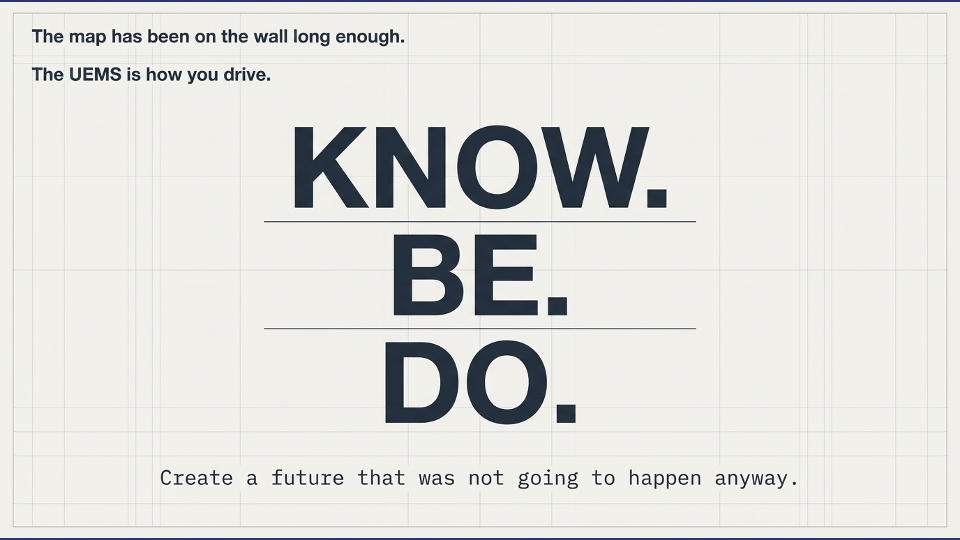
The map has been on the wall long enough. The UEMS is how you drive.
Appendix — RLI Finalization
Seven Domains · Diagnostic Lenses v2.0 · 30-Day 10-20-70 Activation
The introduction reads the UEMS requirement by requirement. This appendix reads it three more ways: down through the seven domains, across through the Diagnostic Lenses, and forward into thirty days of evidence.
Layer 1 — The Seven Domains
Reliability Engineering for Maintenance (REM). All six REM tiles are at work. Criticality Analysis, Reliability Strategy Development, Reliability Centered Design, and Capital Project Management live in 3.0 Planning; Reliability Engineering and Root Cause Analysis live in 7.0 Improvement. That placement is the point. REM is the only domain that reduces failures, and the UEMS puts it at the two moments where failures are prevented: when the strategy is set and when the system learns from what broke.
Asset Condition Management (ACM). All nine tiles are present — eight condition tiles in 5.0 Operations and Asset Condition Information in 6.0 Evaluation. ACM makes the management of failures that occur more efficient. The UEMS asks the question that keeps it honest: does every inspection trace to a failure mode and fit inside its P–F interval?
Work Execution Management (WEM). All six tiles operate. Planning and Scheduling, MRO-Spares Management, and the CMMS sit in 4.0 Support; Preventive Maintenance and Operator Driven Reliability sit in 5.0 Operations; Defect Elimination sits in 7.0 Improvement. WEM is where the management system becomes Tuesday afternoon.
Leadership for Reliability (LER). All six tiles operate, and two of them carry UEMS requirements by name: Executive Sponsorship anchors 2.0 Leadership and Operational Excellence anchors 5.0 Operations. Integrity, Reliability Journey, Human Capital Management, and Competency Based Learning do the supporting work.
Asset Management (AM). All nine tiles operate, and three of them anchor requirements: Strategy and Plans (3.0), Performance Indicators (6.0), and Continuous Improvement (7.0). Five of the seven UEMS anchor tiles come from LER and AM. The management system is a leadership and asset management instrument first.
Digitalization Strategy (IoT). Named nowhere in the introduction. Operating anyway. The data-quality and information-control work in 4.4 is Trustworthiness and Data Governance by another name, and the CMMS spot-check in 4.0 is the Source step of a data path. This is a finding, not an omission to excuse: the UEMS strategy template predates the IoT domain, and its next revision should map Requirement 4.0 to Tr and Dg explicitly.
People and Culture at Work (PCW). Also named nowhere, and also operating. “Establish a culture of reliability leadership” (2.4) and “make sure people are competent and informed” (4.2) are PCW requirements stated in management-system language. Sixty-nine percent of implementation failures trace to people and culture — 35 percent awareness and trust, 34 percent leadership, 23 percent competency, 7 percent empowerment. A UEMS that never names PCW is auditing the 31 percent and hoping about the 69.
What the domain pass shows. Five domains are fully mapped — all thirty-six tiles. The two newest domains are doing real work under other names. The gap is in the template, not the system.
Layer 2 — The Diagnostic Lenses
The core seven
L1 · Performance Indicators (Pi) + MCRS. Requirement 3.4 designs a management control and reporting system and 5.3 uses it. The introduction asks for five paired indicators but does not yet teach the chain that makes them meaningful: strategic objective → theme → tactic (an element) → leading indicator (a commitment to act) → lagging indicator (the result). Without that chain, a reporting system reports. With it, it controls. Gap: name the MCRS and the Pi chain in Requirement 3.4.
L2 · The Four Synergistic Roles. The RACI activity in 2.0 is generic. The UEMS lands faster when the RACI is built around the four roles that carry it — Maintenance Manager, Reliability Manager, Asset Manager, and the IoT role — and the three handoffs between them: what actually broke, what it costs to keep, what matters most. Most organizations already have three of the four roles. Almost none have named who owns the handoffs. Gap: rebuild the RACI around the four roles.
L3 · Trim Tab. The introduction names it correctly: the scope statement (1.3) and the signed policy (2.2). The lens sharpens it to one act. The signature is the Trim Tab. A policy drafted and unsigned changes nothing; a policy signed by top management gives every later requirement its authority.
L4 · UEMS (Plan-Do-Check-Act). The lens is the subject, which makes it a test of the article itself. The loop is complete: Plan (1.0–3.0), Do (4.0–5.0), Check (6.0), Act (7.0), and the 7.0 activity closes back into the data. The one weakness is time. The six-month cadence in “Where to Start” reaches Check but not Act. Enhancement: carry the sequence to a second management review that confirms the first corrective actions.
L5 · AIM — Policy · Strategy · Plan. The sequence is there in the right order — policy in 2.2, strategy and plans in 3.3 — and the four themes open with aligned objectives. What is not yet explicit is the line of sight from the policy to the aim of the business. The Stakeholder Value Mapping in 1.2 supplies it. The policy should cite it.
L6 · Maturity Matrix + GPS Assessment. The reader this introduction serves sits in the Reactive stage: business context not known or well understood, functional islands, high cost and unplanned work. The activities are built to move them into Planned, where work control, planning and scheduling, and improved spares management take hold. A fully running UEMS — one that survives the departure of the sponsor who started it — is the signature of the High Reliability Organization stage, where the outcome is persistent reliability leadership. The rows that separate those stages are Business Context and Business Result, and Requirements 1.0 and 2.0 are written to move both. Enhancement: open the sequence with a GPS assessment so the reader has a baseline to measure the six months against.
L7 · The Declaration. Absent. The introduction asks for a signed policy and never asks the leader to declare a future. A policy states what the organization will do. A Declaration of Reliability states who the organization intends to become, and it gives the policy something to be accountable to. Gap: precede the policy with a Declaration, then write the policy to deliver it.
Applied lenses — where they deepen
L8 · REM–WEM Feedback Loop. The 7.0 activity — take a repeat failure to closure and verify the fix in the data three months later — is the feedback loop in miniature. It works only if the CMMS failure codes checked in 4.0 describe what actually broke. The lens connects two activities the introduction kept apart.
L10 · ACM + IoT Plant Coverage. The P–F activity in 5.0 asks whether each inspection fits its failure mode. Coverage asks the next question: across the critical assets, which failure modes have no detection at all? That map belongs in 3.3 strategy, not only in 5.0 operations.
L11 · 10 Rights of Asset Lifecycle Management + S-D-I-P-F™ Curve. The long-term strategic view theme and the Rcd and Cp tiles in 3.0 point to the early lifecycle, but every operational activity in the introduction works the P–F window. The Trim Tab on the S-D-I-P-F™ curve is 1R-Specify and 2R-Design. Gap: add one Planning activity that reviews a live capital project specification for reliability requirements.
L12 · Regenerative Reliability™ & Sustainability. ISO 14001 is cited and the triple bottom line is not. A UEMS that integrates with an environmental management system has every reason to show that reliability delivers economic benefit, environmental sustainability, and social responsibility together. Gap: name it in the Context requirement, where stakeholder needs are defined.
L13 · IoT Digitalization Strategy + 10 Rights of Digitalization + 10 Rights of AI. The crosswalk names ISO/IEC 42001, and the UEMS’s own Requirement 4.4 asks for available, reliable, secure data. Governance comes before analytics. The 10 Rights of Digitalization give 4.4 its practical test, starting with the Right Business Problem Focus.
Not run: L9 Zero Breakdown Leadership and L14 DE & ODR. The introduction operates Defect Elimination and Operator Driven Reliability at tile level only; a lens pass here would be padding.
Layer 3 — 30-Day 10-20-70 Activation
Aim: produce the UEMS Trim Tab — a signed policy grounded in a declared future — and a baseline you can measure against. Evidence: four artifacts for your Certified Reliability Leader portfolio.
Week 1 — Assess. 10 · Formal: Study Requirements 1.0 and 2.0 in the Uptime® Elements Management System e-book (about three hours). 70 · Experiential: Score your site against all twenty-eight UEMS sub-requirements (1.1–7.4) on a simple scale: no evidence, partial evidence, documented evidence. Place your site on the Maturity Matrix. Artifact:UEMS baseline scorecard.
Week 2 — Plan. 70 · Experiential: Run the Stakeholder Value Mapping exercise for one site. Draft a one-paragraph Declaration of Reliability, a one-page scope statement, and a one-page reliability and asset management policy written to deliver the Declaration. 20 · Social: Review all three drafts with a Certified Reliability Leader or an AMP peer outside your site. Artifact: Stakeholder map, Declaration, scope, and draft policy.
Week 3 — Act. 70 · Experiential: Take the policy to top management for signature. Build the RACI for five cross-functional decisions around the Four Synergistic Roles, naming an owner for each of the three handoffs. Artifact: Signed policy and role-based RACI.
Week 4 — Measure & Share. 70 · Experiential: Re-score the twenty-eight sub-requirements. The target is movement in 1.2, 1.3, 2.2, and 2.3 from “no evidence” to “documented evidence.” 20 · Social: Present the before-and-after scorecard to your team in ten minutes and share it with your AMP peer group. Artifact: Before-and-after scorecard with a one-paragraph reflection on what the signature changed.
Measure of success: a signed policy, four sub-requirements with documented evidence that had none thirty days earlier, and a named owner for every handoff.
Know. Be. Do. And create a future that was not going to happen anyway.
Uptime® Elements, Reliability Leadership Institute®, Regenerative Reliability™, and S-D-I-P-F™ are trademarks of Reliability Leadership Institute LLC. ©2026 Reliability Leadership Institute®.