
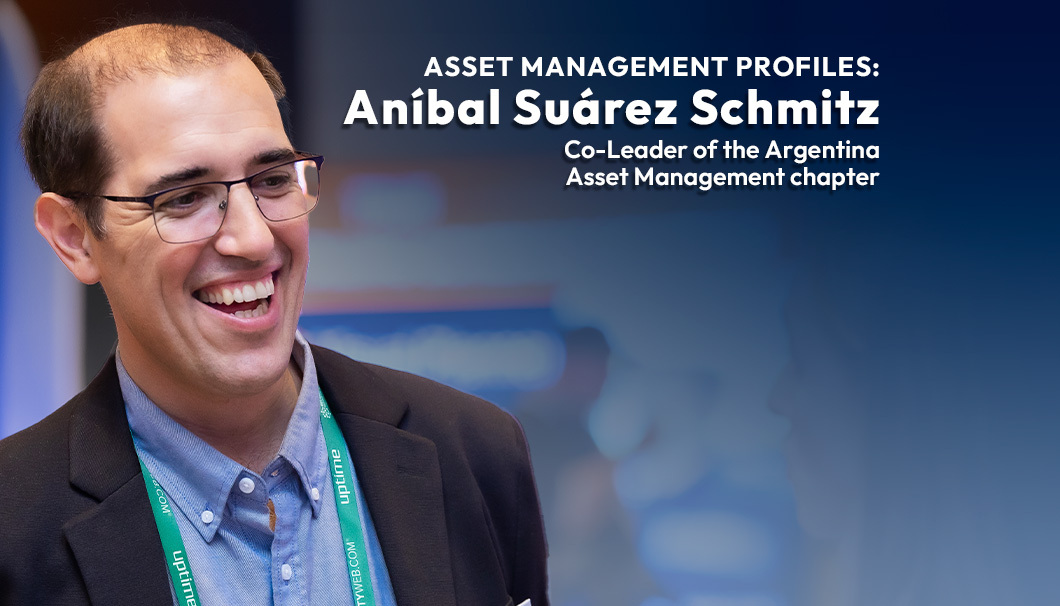
The CEO of GenIA Soluciones Inteligentes and Co-Leader of the Argentina Chapter of the Association of Asset Management Professionals shares his vision in this interview on the evolution of asset management in Latin America, the impact of digitalization, and the value of experience in building strong leadership.
By Alimey Díaz. Journalist & Technical Writer
Men in the maintenance industry share a common trait: they are committed, even in difficult circumstances, hostile environments, and the face of constant change. Aníbal Suarez Schmitz is one such professional in the maintenance and asset management industry, who took his first steps in summer jobs, performing plant repairs and learning from experienced industrial workers. He later graduated with a degree in Mechanical Engineering from the National Technological University (Argentina), earned a master’s degree in maintenance engineering from UADE, and became a specialist in non-destructive and structural testing. He is currently CEO of GenIA Soluciones Inteligentes, an organization focused on providing autonomous robotic inspection solutions in industrial environments, following a long career working for companies such as Pan American Energy and YPF.
Aníbal is also Chapter Co-leader of the Association of Asset Management Professionals (AMP) chapter in Argentina, where he promotes initiatives to host webinars aimed at expanding and disseminating knowledge regarding asset management, industrial maintenance, and topics relevant to our industry. We spoke with Aníbal about his career, his business vision, and his perspective on asset management in Latin America.
1. Aníbal, thank you for agreeing to this interview. Tell us a little about your current work as CEO of GenIA Soluciones Inteligentes. What is it like to work with autonomous robotic inspection focused on industrial reliability in the Argentine context? What are the main challenges, and what do you hope to achieve by 2026?
AS: My work at GenIA combines three things I’m deeply passionate about: engineering, real industry, and shaping the future. We’re an Argentine company that develops and integrates autonomous robotic inspection solutions powered by artificial intelligence, focused on reliability, asset integrity, and operational safety—primarily for the oil & gas, energy, mining, and capital-intensive industries. Working in this field in Argentina is as challenging as it is stimulating. We have world-class industrial assets, highly skilled professionals, and opportunities to improve industrial reliability and address competitiveness challenges… but we also face budget constraints, complex and changing macroeconomic contexts, and an uneven technological gap across the country and across industries.
Our interviewee explains that one of the main challenges is to demonstrate value quickly, making it clear that a robot is not a gadget but an asset that rapidly impacts productivity, reduces failures, and improves decision-making. He highlights that by 2026, his organization has set out to:
- Expand in Latin America, bringing solutions to more industries and countries in the region.
- Enable the regional adoption of solutions that directly impact organizations’ real competitiveness, reducing operational risks and improving decision-making.
- Position GenIA as a trusted technology partner for modern asset management.
2. You have a long professional career in the field of Maintenance and Asset Management. What sparked your interest in this field, and how did you get started in the profession?
AS: I started very early, between the ages of 18 and 20, when I was beginning my engineering studies, working during the summers as a technician on major repairs and plant shutdowns—what we in the industry refer to as shutdowns or turnarounds. Those were intense months, since I wasn’t sitting in front of a computer: I was inside the plant with tools in hand, assisting expert technicians who were authorities in their field, and who taught me and shared their experiences when they saw how committed I was. This experience allowed me to connect with reality, to understand that models, calculations, and procedures only have value if they work in the physical world—with heat, noise, dirt, constraints, and real people with different skills. Beyond technology, the principles of reliability, safety, and asset management are universal, but that initial phase in the field shaped my view of the profession forever. I often use a simple analogy: looking at photos of Patagonia on a screen is not the same as standing in front of a glacier in the real wind and cold. In reliability, it’s the same: you have to go there, listen to the plant, feel the operation. Many failures or defects don’t usually have instrumentation to alert you. Technology enhances, but it doesn’t replace the physical reality of the assets.
3. Your current work is particularly connected to Industry 4.0, robotics, and digitalization. What is your perception of the progress of digitalization and robotics in Latin America, specifically regarding asset management and maintenance?
AS: Latin America is making progress, but unevenly. First, there are leading companies that already use advanced analytics, sensors, digital twins, and are beginning to adopt robotics. Then there is a large group that is digitizing basic processes. And a third group that still operates in a very reactive manner. Robotics applied to asset management is just getting started in the region, and this is a huge opportunity. In our experience, when a company sees a robot performing autonomous rounds, measuring temperature, detecting leaks or anomalies, and delivering structured reports, the cultural shift is immediate: the conversation shifts from “does it work” to “how do we scale this.” I believe that in the next 10 years, robotics will be as commonplace as CMMS or online monitoring is today.
Regarding the evolution of the industrial asset management business in South America over the coming years, our interviewee highlights five trends:
- An increase in decisions based on real data and near-real-time information
- Greater integration between operations, maintenance, and reliability, driven by the integration of information and cross-referenced data
- A greater focus on concrete solutions that enable greater competitiveness while ensuring industrial safety
- Automation of routine inspections
- A growing role for artificial intelligence as a technical assistant
- Creation of departments or roles within engineering firms dedicated to robotics, as key positions
- Asset management will focus on optimizing complex systems.
4. Your participation in the Association of Asset Management Professionals as Chapter Co-Leader, what does this mean to you, and what would you like to continue contributing?
AS: It means a lot to me both professionally and personally. I had the honor of being appointed by AMP to launch the Argentine Chapter of AMP, the first in Latin America, and I am immensely proud to see how the regional community has grown. I am also honored to be certified as a CRL—Certified Reliability Leader. During my career, I had the opportunity to lead the reliability department at a large company that won two Uptime Awards, both for digital transformation and for the best asset management program—something that isn’t achieved with tools alone, but by fostering a culture of commitment and team excellence, sustaining best practices over the long term, and sharing knowledge across disciplines. Working in this way allows organizations to rotate their staff, but the method remains. And that is what we could call SUCCESS. I deeply believe in building a technical community. No one transforms the industry alone.
Through our chapter, we aim to:
- Share real-world best practices
- Connect companies, professionals, and universities
- Raise the region’s technical standards
- Create a space where we talk less about trends and more about practical results
I’d like to continue offering a very pragmatic perspective: what works on the shop floor, what doesn’t, and why. That’s the spirit of AMP—having a community of practitioners.
5. Do you have any recommendations you’d like to share with new reliability and industrial asset management engineers?
AS: Yes, several, but I’ll summarize them into three. First, get out on the shop floor. No software can replace understanding how a pump sounds when it’s about to fail, or how a pipe vibrates—ask the staff what they’re doing. Second, it’s essential to learn how to communicate. A good engineer must be able to explain the economic impact of their recommendations and share knowledge with operations colleagues. Think in terms of systems, not isolated pieces of equipment. And one final, very personal recommendation, which I also repeat often: Don’t wait until you have the title to lead. Clay Scroggins sums it up very well in his book How to Lead When You’re Not in Charge: “Influence always trumps authority. The best leaders lead as if they weren’t in charge, even when they are.” Influence is built on technical expertise, consistency, communication, respect, and sustained results. That never goes out of style, not even in the age of robots.