
[Season 2 – Episode 27]
Continue investing in you people – Jim Barlow – JLL -#AMV27
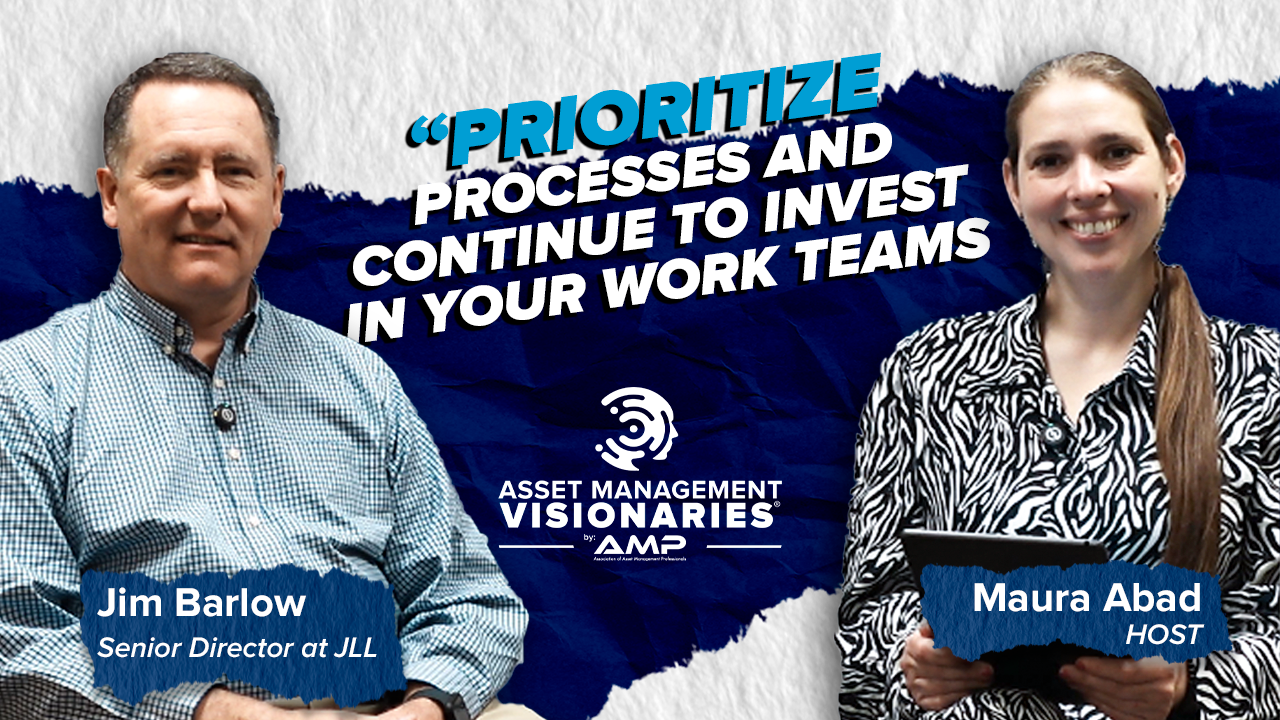
Jim Barlow, Sr. Director, Solution Strategy at JLL, talks to Maura Abad about how technology supports leadership processes and how they impact the Facility Management business. Investing in technology is important in an ever-changing industry, but investing in people and teams is a bonus that defines a winning organization. This and much more in our new podcast.

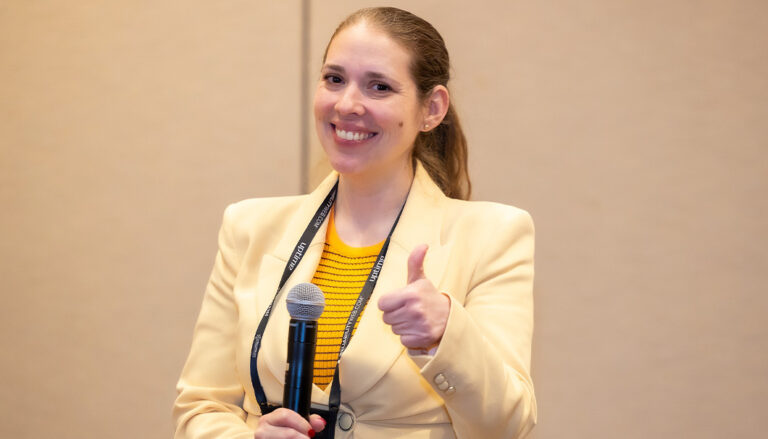
Maura Abad is the Global Director of Women in Reliability and Asset Management (WIRAM) and AMP Global Chapters. She is a passionate advocate of asset management as a strategy for achieving a safe world and a sustainable future, and for decades she has worked hard to communicate this message to as many organizations and professionals as possible. As host of the Asset Management Visionaries Podcast, Shaping Tomorrow, she conducts in-depth interviews with renowned industry leaders, creating brilliant communication dynamics that favor the knowledge and integration of new approaches, available to all Reliability, Industrial Maintenance and Asset Management professionals through the website of the Association of Asset Management Professionals and various information channels.

Jim Barlow is Senior Director at JLL Technologies, where he helps clients optimize their facilities for lasting improvement. He has worked as a facilities solutions architect at the Smithsonian Institution and held leadership roles at organizations such as Accenture and Deloitte.
Text Transcript
J.B: Process first but continue to invest in your people and in understanding what your evolving needs are. Be prepared to come back and improve the process and the technology that’s enabling those processes.
M.A: Hello, world! Maura Abad, Asset Management Visionaries, Shaping Tomorrow, under the Association of Asset Management Professionals. We have a guest today, Jim Barlow. Jim, welcome.
J.B: Thank you very much. Good to be here.
M.A: I am so honored to have you, and again this is my favorite space because I get to know a little bit about you, who you are as a person, as a professional, but let’s dive in straight. Tell the world who is Jim Barlow.
J.B: Well, I’ve been in the business for a long time in the context where people used to come up through the ranks, you had kind of the practitioners who had to pick up technology. Now you see a lot more people who are approaching the tools in their own. I come from the world where we were deep in, up to our eyeballs in the process, and we were looking for efficiencies, how we could use tools to automate steps. I’m a practitioner, I’m a consultant, I’m an implementer. I’m a process advisor.
M.A: And Jim. from everything that you have done in your career, we know that you have worked at Smithsonian at Center Deloitte, among others, and now JLL. Walk us through that pathway in your career and why facility management.
J.B: It’s been really a treasured opportunity. I think I’ve had opportunities that others may never get a chance to experience because of the need to really innovate and solve. In this space, everybody’s got a portfolio. The question is how you’re gonna adapt. In a sense, it’s the same issues actually from decades ago, with different tools and fresh takes on things. I had been a space manager in my earliest days, before there were tools that did the kinds of things we see today. I picked up a CAD magazine and I read and I self-studied and I figured out ways to run list routines to pull information out of drawings. I was able to do space planning and billing before ERP systems, did a lot of those kinds of things. And then I I began to think about how to take those to other organizations and to export the concepts for reuse as you see. I’ve been through a number of different firms often, meeting real estate where it was regardless of industry. I think over the years, I’ve had the opportunity to work for seven different companies that were Fortune 10, which is probably pretty hard to meet. I’ve been in government living in Washington DC, I’ve been in commercial kind of across the board, really trying to solve real estate or facility issues where they live.
M.A: What a career! And in your career, Jim, tell us a little bit what do you see out there. What are the challenges, especially with us in management implementation?
J.B: Well, I would say if I roll back to my earliest days, a statistic that just continues to stun me, is that this is usually the second largest spend for any organization, and yet it’s the most elusive to most organizations, how they really get their arms on inventory need managing utilization and when you say the phrase asset, I find that interesting that depending on your space, sometimes the building is the asset. There could be real property assets, there could be assets that are building equipment, and there can be things even smaller than that. The key is making sure that we know what our key needs are to put the asset in the right place and to work on its right use, when it should be replaced, how many do I have to have, Having the key spares in place, the more critical the asset is, the more you have to be ready to see your mission, continue without impacting business.
M.A: Which one would you say is the most critical asset in facility management?
J.B: I think your question is really funny to me. What is the facility? A lot of that has to do with business. If I’m in data centers, if I’m in manufacturing, if I’m in defense, obviously there’s certain connotations to what the mission is, and finding those assets. I’m in a large corporation and I’m primarily dealing with office towers. I’ve got a different sense of what my key assets are, so if I think of your question, it’s really about identifying criticality based on a risk factor, what it would cost to suffer a disruption in that space, and truly you’d see very different answers if you’re in a utility or a transit or something like that, where asset takes on that connotation versus trying to run your business without disruption, your financial services firm or something that’s more in an office environment, your sense of what’s necessary or what the risks are, are really gonna be different.
M.A: Definitely. Jim, in your career, what is the moment that you’re most proud of?
J.B: I would say, I kind of grew up in the space not really knowing what was happening to me. I’m just solving, and things would evolve as the time went on. I think I would answer the idea of being able to take spatial data applied to a very real situation in not a lot of time and really impacting the outcome. Back in the day I spent time on Capitol Hill. I mentioned I’m from Washington DC and I had written routines that supported the election process, a space lottery. It’s a great story because people could think of the Capitol with the dome and the flag, and what have you but the process of taking over 500 separate delegations and understanding what’s available today. What happens if the guy ahead of me makes a decision, what my options are to be able to present all of the information of what offices are available to help me visualize the content, what’s in the office where it sits in their notion of working with constituents. They like to be close to certain things or have a view out the window. Could you imagine being able to say, not a list of spaces, but here’s everything you can imagine to be able to experience before you make that decision.
M.A: I think that was really profound opportunity because it applied the technology in a way that people weren’t even understanding where the information was coming from to give a result. That was a fun time, that is a congratulations on all that experience. I share your excitement as well. Tell us about technology and how do you see technology with facility management, with asset management, the Industry 4.0,
J.B: I would say that we’ve never had more technology than we do today. Every time you turn around, there’s a new piece of software, a new widget, a new version of the notion of what happened on the global scale with the pandemic, and rethinking the way we’re using our space, shuttering certain floors, needing to interrupt automations; you didn’t do lighting or didn’t cool spaces that were effectively not being used or the way you allocated space. Those are really been things that have existed for decades, but reacting to a situation such as Covid or the inverse, as we started coming back into the offices and you still see companies today weekly. There’s yet another new release, it’s the same fundamental idea of let’s understand what my ass is and where I’m trying to get to what the new inputs are: is it an acquisition or is it all of a sudden, a wave of people is coming back from their homes, back to the office and what are the trickling, the echoes that need to happen into that space. I think the idea of expectation for quick answers and quick action has never been higher, but really, it’s the same questions that the practitioners have been dealing with from age old.
M.A: And what is the role that you see with asset management within facility management?
J.B: I would say that it’s the collision of what your function is to the real world, the piece of equipment or the tangible components that are gonna help me to make the space suitable. Often, the occupants, not even supposed to think about the asset the way you use the space isn’t aware of what’s in the ceiling above or behind the wall or happening behind the scenes. But it’s really those things that have to be in place when they’re not there, they’re not functioning correctly, they’re not optimal. That mission of that particular broader asset, the idea of the space, the facility, the room; whatever’s happening in that area gets impacted.
M.A: Wonderful! And then, we know that you have been leading a lot of projects in your organization. Can you also share with the world what awards have you been winning lately?
J.B: Sure. So, while the tools been here for a while, I think everyone thinks of other soccer suites such as your pee going through modernizations, there’s been such a focus on making sure that the data’s moving around mechanics, have access to the information. They have those kinds of considerations that there hasn’t been the same modernization. My team is quite excited that we’ve been recognized for our user experience, being able to take those processes, improve them streamline them, things like present the right amount of data at the right time to really improve, so that is helping adoption from users or making it easier that as you have staff turnover can just move right in without the extent of training or change management. Many reasons why you focus on that. We’ve got a number of UX, user experience: for those who don’t know that acronym awards, and they range across really the full spectrum from work order management to capital projects. Thinking about the inspection or the health of assets and condition assessment into space management, really, they cross that gamut. We’ve been quite lucky to have the recognition and I treasure that opportunity.
M.A: Congratulations, and more successes to come! We are sure now with the world we’re in, sustainability is even more important. Tell us about the role of sustainability and facility management.
J.B: Oh, it’s huge! According to JLL Research, about 40% of energy is from commercial real estate buildings, and what is even more important to think about that question. About 30% of that is actually wasted energy, so as custodians of this space and to be thinking about how to help the organizations, wherever you are in that high performing or just getting started to really manage in that space. I think it’s really critical to understand the assets, to understand their use, the consumption, how that all fits into space. I also think that we’ll see a surge in ESG compliance reporting capabilities. It’s been an area JLL’s really been focused on, trying to invest in; we’ve had a program for a long time to help our customers through the very complex and messy business of data management. We have an offering called Sustainable Program Management, where we’ve relied on the IBM and VC product, we’ve begun to focus in that direction and I believe we’re actually the leader. We have the largest number of implementations of an ESG tool. Certainly, it’s been our focus to try to help people get through the data process. As I say, a very messy situation, to be able to have those insights and then to put that into the full life cycle where you can take the observations, you can do the replacement or the retrofits, or considering other things, maybe it’s a change of mission of the space, or if you in fact know you’re gonna do rooftop reduction, you factor all that in so that you achieve energy efficiency; you make the right moves as a sustainable and socially responsible organization. I think it’s very important to get sustainability to be appropriately plugged into those decisions for the best outcome for your company, for the planet, for achieving the utilization of assets.
M.A: Definitely, and facility management plays a big role in that. Talking about roles, tell us a little bit what your organization is doing, perhaps to recruit more people.
J.B: So very interestingly, we are a global organization, we’re focused on being able to grow individuals and finding people who can be in their local environments. As we think about the overall organization, we’ve recently been sponsoring an IFMA Foundation scholarship that helps to focus on the sustainable facility professional, that’s one of many items. Internally, we’re spending a lot of time trying to cross train and grow individuals who may be in an adjacent space, so they can begin to think about how they play a role in contributing to asset efficiency, to be thinking about whether it’s green leases or specification or construction of real estate assets that are sustainable.
M.A: That’s interesting, and on the part of diversity, we have Women in Reliability and Asset Management, and you have been really an advocate, you have been always supporting the group. I know your company has a lot of diversity efforts as well, so within JLL, there’s a strong focus on our diversity program. We have regional leaders, for example, in Latin America Gabby and others who really take on that focus and are very committed to the process. At a recent Reliabilityweb event, we had a number of individuals who participated in WIRAM functions. Certainly, we want to make sure that all individuals are growing and progressing and providing the opportunities for all our professionals to move forward and engage. Definitely. We know Mary Sam, director of WIRAM in Canada, Gabby Mejia, WIRAM in Latin America, and they’re always out there and we appreciate that collaboration. One important piece about data governance; how important is data in governing that data?
J.B: Sure, I would say that there’s a transcendence from tools to data seeing. I like that comes out of JLL research, data is the new oil and really the concept there is that long after you deal with a piece of software, essentially as long as that piece of property, the building with its key assets is around, there’s now a fundamental need for the digital life of that building. Well, if you’re going to have that lens on data, you’ve got to focus on governance and accuracy. It has to truly reflect the idea of whether you’re in one solution, you change to another solution, you have 10 solutions. it’s all about making sure that our data standards are in the right place, that we’re measuring the right content, that we can have the correct interpretations. When we’re looking at the use of business intelligence tools or beginning to introduce AI in some of those things, those can only be successful with strong data governance, strong understanding of the definitions, the calibrations, the ability to use multiple tools from different directions. Without data governance, you don’t have a single view of the organization or its assets; you can’t make sound decisions, it’s really the key to success for any decision-based tools and the ability to do the right thing in your organization.
M.A: Thank you, Jim, for that perspective. Basically, is making the right decisions with intelligent data. Now Jim, tell us a little bit of call to action to the audience. What would you tell people that perhaps are not starting yet in their asset management journey, might be in the middle or might be world class?
J.B: Sure, I think that there’s no end state, really the concept is you’re on a journey. You should make sure that you’re focused on the process, give yourself the freedom to adapt. I think the key is that the business world and the state of technology converging is making the questions we ask tomorrow different than today, and so therefore, there’s a saying: don’t let best get in the way of better. You should be moving and incrementing and tuning just as you might think your process or your tool set needs to do that, too. Process first, but continue to invest in your people and in understanding what your evolving needs are. Be prepared to come back and improve the process and the technology that’s enabling those processes.
M.A: And I love that it’s about people investing in your people. Great advice and always leveraging that with human capital management, with HR, because people really want to see a pathway in their careers. We are super honored for the interview, Jim. We wish you so much success, we cannot wait to see what Jim will be bringing to our community. Thank you again for sharing your knowledge, your expertise, and we’re looking forward for another interview, when you do more activities. I’m quite sure of that. On behalf of the Association of Asset Management Professionals, we invite you to follow this interview to share and also to follow us in the different social media where we are on different platforms, more to come on Season 2 with Asset Management Visionaries, Shaping Tomorrow. Stay tuned for more. We’ll see you soon.