
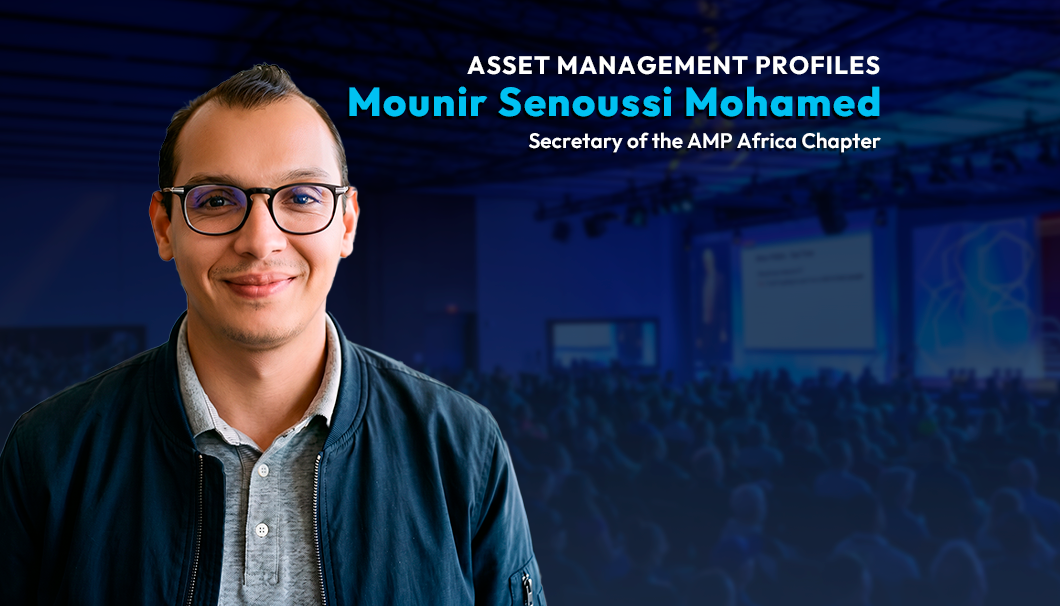
Mounir is Secretary of the AMP Africa Chapter and an independent consultant specializing in asset management, CMMS/EAM, and digital transformation in industrial environments. He shares his views on digitization, corporate culture, the impact of new technologies, and more.*
By Alimey Diaz
Asset management has become the distinguishing factor between an organization that does its job well and one that can compete at the highest level. At the Association of Asset Management Professionals (AMP), we work to promote knowledge sharing and raise awareness about asset management. To this end, we organize webinars and conferences through our Global Chapters around the world, which are made up of experts who share their experiences and valuable insights for the industry.
One such expert is Mounir Senoussi Mohamed, Secretary of the AMP Africa Chapter and an independent consultant specializing in asset management, CMMS/EAM, and digital transformation in industrial settings, who kindly agreed to grant us this interview for our AMP Profiles section, addressing topics that reflect the reality of our industry and its evolution.
AMP: Thank you for agreeing to this interview. Tell us a little about your work and your current position.
Mounir Senoussi Mohamed: I am an independent consultant specializing in asset management, CMMS/EAM, and digital transformation in industrial environments. My expertise lies at the intersection of several areas that are often managed separately: maintenance, asset management, operational performance, industrial information systems, and digitalization. My work typically covers the entire transformation lifecycle: assessment of the current state and maturity level, process analysis, definition of the target state, strategy and solution selection, functional design, data preparation and governance, integration, migration, change management, training, and implementation support. The success of an EAM transformation depends on an organization’s ability to align its strategy, processes, data, people and technology, that is what I strive to foster in the projects I work on.
AMP: You’re an expert in CMMS. What are the biggest challenges you’ve faced in your work when it comes to getting your staff to use the CMMS and make the most of its benefits?
MSM: In my experience, the biggest challenge is organizational culture and the organization’s ability to change the way it works. Implementing a CMMS/EAM is a transformation of maintenance practices and, in a broader sense, of the organization’s operating model. Likewise, data preparation is one of the aspects that is often underestimated. Before migrating data to a CMMS, an organization must define what constitutes an asset, its level of criticality, the relationships between equipment, locations, spare parts, and maintenance processes, while also ensuring the quality, consistency, and governance of the data.
There is also a human dimension. Maintenance teams may sometimes perceive the CMMS as an additional administrative burden or even as a control mechanism; therefore, it is up to us to demonstrate its practical value: better work planning, access to equipment history, improved decision-making, and the ability to capture and share technicians’ expertise, among other benefits. A CMMS/EAM is not simply a software tool: it is a technology-enabled maintenance and asset management system that helps an organization manage its assets more effectively.
Digitalization: Rapid Advances in the Asset Management Industry
Digitalization is rapidly becoming a massive trend within the asset management industry, and it is advancing much faster than systems, people, regulations, ethical considerations, or laws. While this may be a cause for concern, it is no less true that the benefits of digitalization in industry deliver exponential results. We asked our interviewee, based on his experience, what to expect from digitization in the near future.
AMP: In what direction do you think digitization in asset management will continue to evolve, and what should we expect in the coming years?
MSM: I believe we are gradually shifting from the digitization of individual tools to the digitization of the entire operating system. For many years, organizations digitized their functions in isolation: ERP for business management, CMMS for maintenance, SCADA for monitoring, BMS for buildings and utilities, OEE systems for industrial performance, and, later, IIoT platforms to collect ever-increasing amounts of data. The next step is to make these components function as a connected ecosystem, so that EAM can then use that information to improve maintenance, asset management, and decision-making.
This is gradually leading us toward an approach based on the asset’s actual condition, its criticality, its operational context, and its risk profile. Digital tools will accelerate this evolution, but AI does not solve the problem of poor data governance. In some cases, in fact, it can exacerbate it. Reliable data is needed. Therefore, true transformation will not be purely technological. It will involve creating a continuous cycle:
Data → Information → Decision → Action → Feedback → Improvement.
That is the cycle that will turn digitization into real industrial performance.
Asset Management for Health, Life, and the Environment
One of the most notable characteristics of asset management is its presence, adoption, and impact across multiple industries and organizations, regardless of their nature. Every organization needs to optimize the performance of its assets, reduce costs and risks, and achieve greater financial resilience. There are organizations that, due to the nature of their activities and the services they provide, rely on asset management to function optimally, protecting people’s lives, the environment, and other areas of extreme sensitivity and importance. Here, Mounir shares his expert opinion.
AMP: We like to show our audience the impact of asset management across different sectors. Given your experience, what can you tell us about the impact of asset management in a sector as socially sensitive as the pharmaceutical industry?
MSM: The pharmaceutical sector is likely one of the areas where the maturity of asset management can have the most tangible consequences. A pharmaceutical asset is not simply a machine that must remain available, but an element that directly contributes to product quality, production continuity, regulatory compliance, and, ultimately, the availability of medications for patients.
Therefore, asset management in this type of industry must encompass much more than just availability. It must address:
- Reliability
- Criticality
- Qualification
- Calibration
- Maintenance
- Performance
- Spare parts
- Competency
- Risk and the entire asset lifecycle.
In this context, traceability and data integrity become fundamental aspects. Organizations must be able to demonstrate what was done, when, by whom, and on which asset, and this is how data itself becomes a critical asset.
Therefore, digital transformation projects in the pharmaceutical sector must incorporate quality, traceability, data integrity, and regulatory requirements from the outset, rather than treating regulatory compliance as an additional layer added at the end of the project.
AMP: Following up on the previous question, in the pharmaceutical and healthcare sectors, supply chains are particularly important, as the lives and health of millions of people depend on their smooth operation. What are the best strategies for ensuring a resilient and reliable supply chain for the medical and pharmaceutical industries?
MSM: Resilience begins with visibility and an understanding of dependencies and risks. Pharmaceutical supply chains can be disrupted by many factors: shortages of raw materials, critical suppliers, transportation, quality issues, power outages, production equipment failures, or even information system failures. Therefore, maintenance strategies must be tailored to the level of criticality and risk. Resilience requires managing external dependencies: qualifying alternative suppliers, maintaining adequate safety stock, ensuring the availability of critical spare parts, and periodically testing business continuity and recovery scenarios.
From an Asset Management perspective, this starts with identifying critical assets and understanding their contribution to the value chain. Production equipment, HVAC systems, cold-chain infrastructure, utilities, laboratory equipment, and other assets do not all have the same level of criticality.
Finally, ERP, EAM, production, quality, and inventory systems, as well as supply chain platforms, must exchange consistent information. The goal is not necessarily to centralize everything, but to establish a sufficiently reliable source of information that allows the right decision to be made at the right time. Supply chain resilience is the result of combining technology, processes, people, data, and risk management.
AMP: The carbon footprint is a major concern for industry and the world at large. What do you consider to be the best strategies for addressing this issue?
MSM: The first step is to measure before attempting to optimize. But beyond measurement, the real challenge lies in understanding the causes of energy consumption and linking them to the performance of assets and processes. An asset operating outside its optimal conditions, poorly maintained equipment, a leak, improper regulation, or low-load operation can all lead to significant energy consumption that may not be visible at the overall level.
This is where the convergence of asset management, SCADA, BMS, IIoT, and OEE proves particularly valuable. Operational data can help identify deviations. In this way, maintenance can address their root causes. Asset management can incorporate these factors into lifecycle decisions: repair, refurbish, replace, retrofit, or invest.
Therefore, I believe that reducing the carbon footprint should be integrated into asset management decisions, rather than treated as a standalone initiative. Investment decisions must take into account energy consumption, reliability, maintenance requirements, the availability of spare parts, service life, retrofit opportunities, and end-of-life impact. Therefore, environmental performance is increasingly part of an asset’s overall performance.
Knowledge, information, succession planning, and knowledge transfer: the industry’s current challenges
AMP: One of the main challenges currently facing asset management is the shortage of technical professionals and specialists in new technologies, the aging workforce, and the lack of students in industrial vocational training programs. How do you think the sector can reverse this trend?
MSM: For many years, maintenance was viewed primarily as a support function responsible for repairing equipment when it failed. That perception is now outdated. Modern maintenance sits at the intersection of engineering, reliability, data, automation, the IoT, and asset management. Therefore, we need to develop a true culture of asset management. Continuing education is very important. A maintenance professional should be able to progress gradually, moving from the fundamentals of maintenance toward reliability, asset management, industrial data, and digital technologies.
Professional certifications also play an important role:
- Structure competencies
- Establish common professional standards
- Provide individuals with recognition beyond their own organization.
I believe that industrial companies should place greater value on certification programs in asset management, reliability, and maintenance.
Finally, there is a major challenge regarding knowledge transfer: the retirement of experienced professionals poses a significant risk to the industry, as a great deal of knowledge about equipment and processes remains tacit and is held by individuals. We must convert that knowledge into organizational capital: documentation, maintenance history, standards, reference frameworks, lessons learned, and structured data.
AMP: What kind of incentives should our sector offer to attract young professionals and students interested in industrial work
MSM: To attract younger generations, the industry must demonstrate that it is one of the most technologically advanced environments in which they can work. Today, a young engineer or technician can work in fields such as maintenance, data, AI, IoT, automation, cybersecurity, energy efficiency, and asset management. Therefore, the industry must not only hire qualified personnel but also create career paths that allow those skills to evolve.
We need more university and professional programs dedicated to maintenance management, reliability, industrial maintenance, asset management, CMMS/EAM systems, industrial data, and digital transformation. Universities, engineering schools, training centers, and industry should also collaborate more closely. Students need exposure to real-world industrial scenarios, maintenance projects, CMMS/EAM platforms, SCADA, BMS, IIoT, and the data and performance challenges these entail.
* The views and opinions expressed in this interview are those of the speaker and do not necessarily reflect the official position or policy of the Association of Asset Management Professionals (AMP).