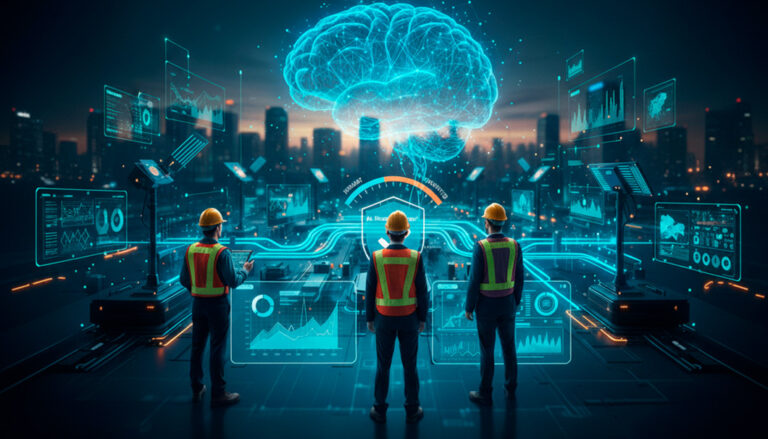

In increasingly digitalized industrial environments, professional profiles with an emphasis on the use of Artificial Intelligence are in high demand, but team leaders must continue to promote communication, ethics, and strategy in order to achieve resilient organizations that are adapted to new challenges.
By Alimey Díaz / Journalist and Technical Writer
To begin this article, I had an entertaining conversation with Gemini, Google’s AI. To my question, “What role does business leadership and industrial asset management play now, if Artificial Intelligence can do so many tasks? What are the most important skills required in the industrial environment, taking Industry 4.0 into account?” Gemini was quite explicit: “In the Industry 4.0 environment, Artificial Intelligence (AI) is responsible for accuracy, but humans must be responsible for purpose.”
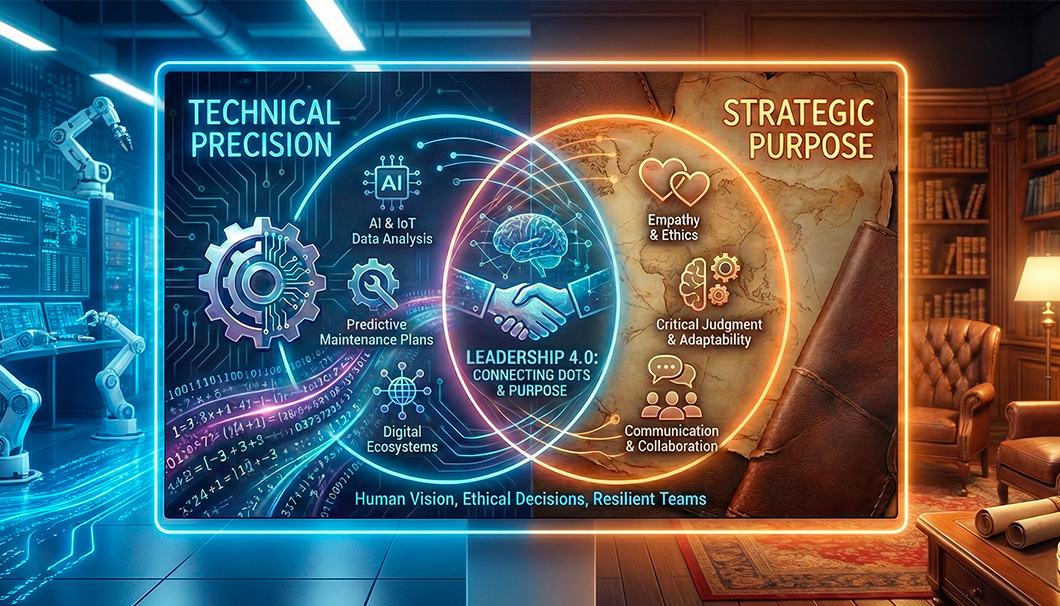
The ability of leaders to connect the dots, understand context, make ethical and operational decisions, resilience, critical judgment, and empathy are now more relevant than ever. Artificial Intelligence takes care of repetitive tasks, calculations, and the creation of maintenance and reliability plans, but judgment, ethics, and overall vision remain human functions, and that (for now) has not changed. In an increasingly digital environment, leadership continues to play a predominant role, and soft skills are still in demand, along with technical skills, now with a focus on AI.
New technical profiles must also have leadership skills and the ability to create strong, ethical, and cohesive work teams. After all, in a highly mechanized, robotized, and digital environment, people still prefer people, because digital tools cannot offer humans what is precisely irreplaceable: the human factor.
Here we offer a brief analysis of the relationship between leadership and digitalization in the context of asset management.
Teamwork, soft skills, and industrial digitalization
The human brain is designed to adapt through one of its main characteristics: neuroplasticity. That is why we are able to learn and integrate knowledge, experiences, emotions, and memories, and produce new ideas and approaches from this adaptive capacity. While the emergence of AI has almost completely revolutionized the asset management industry, reliability, and industrial maintenance, it is no less true that organizations around the world are constantly incorporating AI solutions (according to their degree of maturity) and driving and enhancing their businesses, operational capabilities, and market presence. The problem is that AI is moving much faster than organizations can assimilate, not without a certain amount of vertigo.
Some authors have commented in the past that each technological wave brought with it a series of terms that were more useful in marketing than in practice. Turbo, electronic, laser, nuclear, nanotechnology… the examples are numerous. What has changed with the term digitalization compared to previous technological waves? Immediate responsiveness, cross-cutting nature, data ecosystems, exponential growth, interconnectivity, and many other characteristics. While the aforementioned terms responded to technological advances and approaches that were substituted by others a decade later, digitization and AI are here to stay, replicating and expanding data systems, strategies, information… is the first time in known history, humanity has created more than just a tool: it has planted a tree whose roots, branches, and fruits are constantly growing and expanding in all directions.
But as with everything, the focus on what each organization needs is fundamental. It is neither profitable nor operationally possible to apply and use the entire universe of possibilities offered by digital tools and AI; it is imperative to choose what each organization can take on. Likewise, it is wise for organizational leadership to be guided by this principle: What is the most desirable profile of professionals and technicians for an organization, from the perspective of asset management and the “digital climate” that is now present in all industries? Answering this question will help determine both the type of professional needed and the strategies for raising the level of existing staff, who undoubtedly remain the best asset.
Let’s start from the fact that all professional profiles, from now on, must demonstrate skills to work with AI, to a greater or lesser degree. There is a persistent fear in the industry that AI will replace people’s jobs. This is not necessarily true, but organizations will prioritize hiring workers who are comfortable in digital environments and with an emphasis on the management and use of Artificial Intelligence. However, characteristics related to ethics and social skills remain virtually non-negotiable.
What should team leaders advocate for in the 4.0 environment?
- Long-term goals and strategic vision for the business
- Work ethics, empathy, and interpersonal skills
- Communication and collaboration between work groups
- Strategic approaches and business-oriented operational decisions
- Adaptation to change and innovation
New leaders must not only understand AI as a tool but also contemplate the profound changes that its adoption can cause, and how protecting and empowering their teams can make this adoption, far from causing mistrust, become the natural state of working, managing, deciding, and progressing.
The weight of corporate culture
In the Asset Management approach, culture plays a fundamental role because it is the natural driver of reliability. Reliability is the ability to “do things right, even if no one is watching.” In the current context, someone is watching: a myriad of IoT devices that send millions of data points to interfaces and Edge Computers to be analyzed by AI and emit results that will feed into the organization’s maintenance, operational, and business strategies. If you want to read more about the value of data in the industrial context, read article here.
But beyond this omnipresent, omnichannel Big Brother that industrial digitization implies, the cultural foundations of the company, shared knowledge, and the natural way of acting on the part of technicians, front-line workers, middle managers, and C-level executives must be characterized by reliability and the principles that underpin it.
At the Association of Asset Management Professionals (AMP), we offer our Certified Reliability Leader® certification, which covers all these aspects. This certification, valid worldwide, provides tools that help leaders drive positive changes in their organizations, positively and lastingly influencing work teams and the development of strategies that generate high-impact results for their organizations.
Similarly, our Internet of Things Leader Badge is an accolade aimed at professionals specializing in digitization and the Internet of Things (IoT), demonstrating the holder’s extensive knowledge and experience in integrating digitalization strategies to optimize asset performance and reliability. Consider these certifications and Badges to help your company and the people under your charge adopt new technologies, with proactive approaches that promote communication, cohesion, and adaptability, while advancing your own career and continuing to demonstrate your skills and knowledge.
AMP encourages professionals to master the evolving scope of AI and digitalization while cultivating the foundation of world-class organizations: a culture of trust built on leadership, ethics, and strategic vision.
Sources:
- https://www.harvardbusiness.org/https://www.eidesign.net/
- https://www.workplacepeaceinstitute.com/https://www.oxford-group.com/
- https://letraslibres.com/economiahttps://www.aden.org/business-magazine/
- https://executive.berkeley.edu/
- https://www.resourcegroupholdings.com/
- https://trainingindustry.com/magazine/winter-2025