
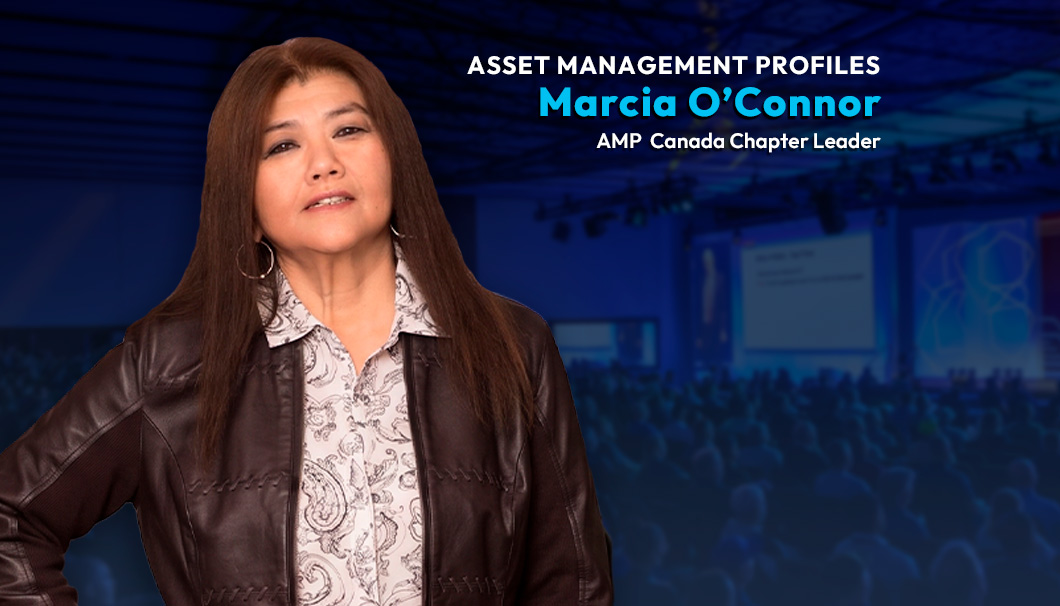
The AMP Canada Chapter Leader, and President and Founder AM FM Consulting Group Inc., shares her perspective on Asset Management and Facility Management, and how both disciplines impact people, sustainability, and organizational growth.
How do Facility Management (FM) and Asset Management (AM) influence people, business performance, society, and the environment? There are many variables involved, but Marcia O’Connor, President and Founder AM FM Consulting Group Inc., offers the kind of clarity that comes from decades of experience, leadership, and a deep commitment to mentoring the next generation. An educator, speaker, and industry leader specializing in FM and corporate real estate, Marcia has dedicated her career to advancing these fields. In this interview, she reflects on her professional journey, the evolving balance between operational agility and long-term strategy, and the immense satisfaction she finds in helping others succeed, a responsibility she describes as “the greatest privilege and the most enduring legacy I can imagine”.
Facility Management: A Field That Evolves to Improve Lives and the Environment
Caring for people, infrastructure, the environment, and financial performance are values shared by both Asset Management and Facility Management. Today, technological advancements, digitalization, and climate indicators are integral to strategic planning in both disciplines. In the case of Facility Management, a profession deeply tied to human well-being and safety, success requires minds that are as empathetic as they are strategic. We spoke with Marcia about her current work, her vision for the industry, and the power of knowledge sharing.
- AMP: What is the most complex part of your current work?
Marcia O´Connor: The most complex part of my work today is balancing the operational realities of Facility Management with the long-term strategic discipline of Asset Management. FM is fast, dynamic, and people-centered, issues unfold in real time. AM requires patience, data discipline, and a long-term view. The challenge is integrating both worlds so organizations can make decisions that are not only efficient today, but sustainable tomorrow. Helping teams bridge that gap, culturally, technically, and operationally is where the real complexity lies, and it is also where I find the most meaning. Throughout my career, I have been fortunate to help build programs, professional communities, and learning opportunities that strengthen both individuals and the profession as a whole.
- AMP: How does leadership in Facility Management differ from leadership in Asset Management?
MO: Leadership in FM is about responsiveness, communication, and building trust with frontline teams and clients. It is hands-on, human, and rooted in service delivery. Leadership in AM is more strategic: it requires systems thinking, risk management, lifecycle planning, and the ability to translate data into decisions. The strongest leaders understand that these disciplines are interconnected. FM leaders manage today’s realities, while AM leaders help shape tomorrow’s outcomes. Throughout my career, I have focused on helping professionals develop the skills to navigate both perspectives.
- AMP: You have extensive experience as an educator and mentor. How do you inspire your students and awaken a genuine desire to learn?
MO: I start by making the work real. Students connect when they understand that FM and AM are ultimately about people: safety, accessibility, comfort, dignity, and community well-being.I use real-world scenarios, lived experiences, and practical tools they can immediately apply in their workplaces. I also believe in treating every learner as a future leader. Whether I am teaching in a classroom, mentoring emerging professionals, or speaking at industry events, my goal is to build confidence as much as competence. When people feel seen, supported, and challenged, they rise to the occasion. The greatest reward is watching former students become leaders who are now shaping our profession themselves.
- AMP: You’ve been leading the AMP Chapter Canada for the past few years. What has this experience been like, and how do you hope the chapter will grow?
MO: Leading AMP Chapter Canada has been one of the most rewarding leadership experiences of my career. It has allowed me to connect with passionate FM and AM professionals from every corner of the country and help foster meaningful conversations about the future of our industries. My vision is for the chapter to continue growing as a national community of leaders, learners, and innovators. I want AMP Canada to be recognized not only as a source of knowledge, but as a place where professionals can build relationships, share ideas, mentor one another, and advance the profession together. Canada has extraordinary talent, and our greatest opportunity lies in creating more pathways for collaboration and leadership development.
Mentoring and Inclusion: Paving the Way for Future Generations
As a woman in a historically male-dominated field, Marcia’s early career required resilience and determination. Today, she stands as a trailblazer who has paved the way for emerging women leaders in Asset and Facility Management.
- AMP: As a woman with great professional success, what gender-related challenges did you face early in your career, and how did you overcome them?
MO: When I began my career, FM and AM were largely male-dominated fields, and women often had to work harder to have their expertise recognized. There were times when my technical knowledge, leadership capabilities, or career aspirations were questioned before I had the opportunity to demonstrate them. I learned to meet those challenges through preparation, persistence, and performance. I focused on delivering results, building credibility, and continuously developing my skills. Equally important, I sought out mentors and professional networks that encouraged growth. Today, I view leadership as creating opportunities for others. I am proud to see more women entering FM and AM and assuming leadership roles across the industry. If I have made a contribution, I hope it has been helping demonstrate that leadership comes in many forms and helping create a space where talent, expertise, and potential are recognized regardless of gender.
- AMP: What impact do new technologies and digitalization have on Facility Management? What tools are most effective today?
MO: Technology has transformed FM. Digitalization allows us to predict failures, optimize energy use, improve occupant experience, and manage assets with far greater accuracy. Tools such as CMMS platforms, IoT sensors, digital twins, and smart building analytics have become increasingly valuable. However, technology alone is not the answer. The real value comes from integrating data, people, and processes to support better decision-making. FM is becoming more strategic because we finally have the tools to see what is happening behind the walls, above the ceilings, and across the entire lifecycle of our assets.
- AMP: What are the most notable differences between Facility Management today and when you started your career?
MO: The biggest differences are technology, climate expectations, and client priorities. When I started, FM was often viewed as a cost center focused primarily on maintenance and repairs. Today, FM is recognized as a strategic function that contributes to sustainability, resilience, accessibility, risk management, and overall organizational performance. Climate change has brought energy management and carbon reduction to the forefront, while clients expect transparency, data-driven decisions, and proactive planning. FM has evolved from “fixing buildings” to optimizing environments and supporting organizational success.
- AMP: How has the rise of accessibility and inclusion influenced building construction and Facility Management?
MO: Accessibility has shifted from being viewed as a compliance requirement to being recognized as a human-rights expectation. Buildings must serve everyone, and FM plays a critical role in making that vision a reality. Inclusive design, barrier-free access, sensory-friendly spaces, and universal washrooms are now central considerations in both construction and operations. FM professionals are responsible for maintaining these features, training staff, and ensuring environments remain safe, dignified, and welcoming. This evolution has strengthened our profession because it reminds us that buildings exist for people, not the other way around.
- AMP: How would you define the impact of asset management and change management strategies within Facility Management?
MO: Asset management provides the strategic backbone for Facility Management. It connects daily operations to long-term planning, risk management, service delivery, and financial stewardship. Change management complements this by ensuring that people are supported through transition. Whether organizations are adopting new technologies, processes, or ways of working, successful change depends on trust, communication, and engagement. Together, asset management and change management help organizations make smarter decisions, reduce surprises, build resilience, and adapt with confidence.
- AMP: You pioneered the first FM Certificate Program at the University of Toronto and recently received the Achievement of Excellence Teacher’s Award. What did this experience mean to you?
MO: Creating the FM Certificate Program at the University of Toronto is one of the achievements I am most proud of, as it helped establish a recognized pathway for professional development in a field that has often worked behind the scenes despite its tremendous impact. Receiving the Achievement of Excellence Teacher’s Award was deeply meaningful because it came from the very community I care most about serving: learners and practitioners. While awards are always appreciated, what matters most to me is knowing that I have helped people build confidence, advance their careers, discover their leadership potential, and contribute meaningfully to their organizations and communities. Education has been a constant thread throughout my career. Whether in the classroom, on a conference stage, or through mentoring, I have always believed that “knowledge shared is leadership multiplied”. Helping others succeed is both the greatest privilege and the most lasting legacy I can imagine.