
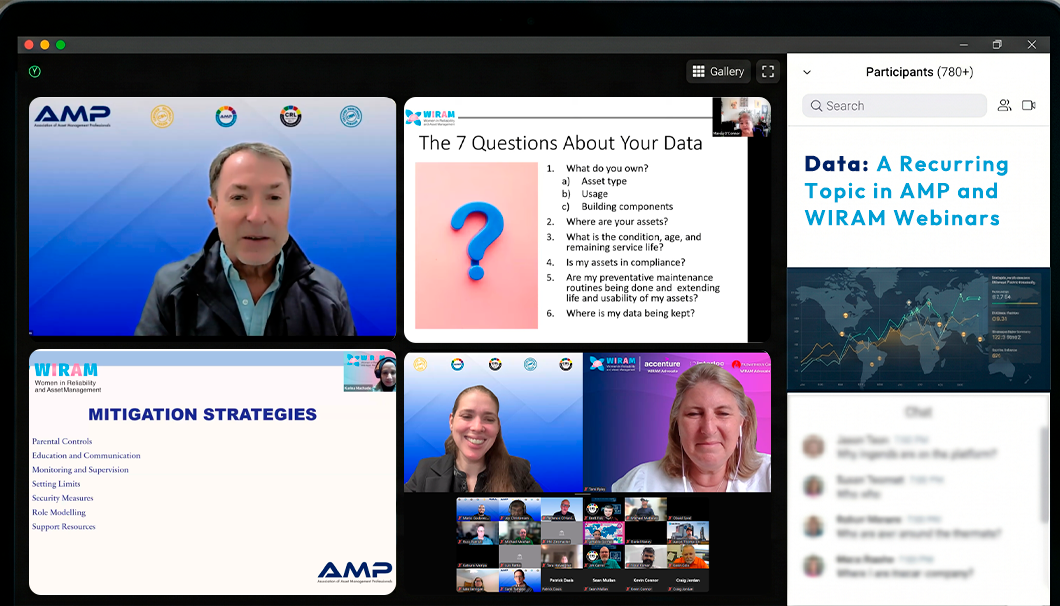
Professionals participating in webinars hosted by the Association of Asset Management Professionals (AMP) and Women in Reliability and Asset Management (WIRAM) agree on the impact of data on safety, profitability, and sustainability. Here are some of the most notable webinars on this topic.
At the Association of Asset Management Professionals (AMP) and Women in Reliability and Asset Management (WIRAM), we host a comprehensive calendar of webinars throughout the year, where asset management professionals from around the world share knowledge and exchange ideas, while also addressing the industry’s most pressing concerns. Data is a recurring theme in our webinars, given its impact on industrial asset management, manufacturing companies, services and safety.
Among our objectives is to raise awareness, build knowledge, and disseminate information on all aspects of asset management, and our webinars are a core activity within our organization because they are the fastest way to bring hundreds of professionals together from around the world to discuss topics and concerns inherent to the industry. Here, we present a selection of these webinars, all of which focus on data as a resource and the best tools for leveraging it effectively.
The Criticality of Bad Data in Asset Management Decisions
This is the title of the webinar held on December 2, 2025, by the AMP Canada Chapter, which covered the topic extensively, with a focus on asset management and IoT. This webinar was led by Marcia O’Connor, Chapter Director, with the participation of Steven Desrocher, President of ASI Technologies Inc., who also has extensive experience at the Ministry of Transportation.
Desrocher noted that while everyone seems to understand the importance of data, within asset management it is of paramount importance. “Asset management is a set of circular processes that requires various disciplines, people, and functions, where data has a major impact on risk calculation. Data is the foundation from which every strategy begins, and its transparency is essential” -he said.
Here are some of the highlights of his presentation:
- Data is a continuous activity, and the collection and evaluation of data are also continuous activities
- The methodology used to collect data must also be reliable.
- The sustainability of data depends on both the cleanliness and accuracy of the data and the collection methods.
- Erroneous or outdated data contributes to poor decision-making, which will ripple throughout the entire system.
- The solutions provided by data management software must be open, accessible, and must meet general needs in terms of technology and support.
“How good is your data?”
A similar concern was addressed in the webinar “How Good is your data?”, an event held on April 24, 2024, by WIRAM Canada, led by Mary Sam and featuring Marcia O’Connor as the speaker. “The reason we want data is that we want to be able to evaluate, measure, and document what we actually have in the realm of real estate assets. Better data helps us determine financing strategies. With poor data, we won’t have the opportunity to secure the money or resources we need; we won’t have a truly reliable strategy” -said Marcia.
She added that data connects absolutely everything, and whether it’s good or bad, we base our future on the existing data.
The key takeaways from this webinar, as presented by Marcia in the context of Facility Management, were:
- In asset management, the ability to obtain data impacts the conclusions and predictability of systems.
- Data gaps affect investment programs, even if the rest of the data is adequate. Data cleansing takes a lot of time, but not using clean data will be very costly for the organization.
- Validating and verifying data—even if it must be done manually—will always be more cost-effective than working with corrupt or incomplete data.
- Unifying or identifying data sources and establishing data recording and storage systems in line with the organization’s needs is part of a good strategy.
- Data entry and authorization processes must follow strict authorization and security protocols.
- AI tools greatly benefit data collection, allow for data visualization, provide a clearer understanding of asset management strategy, and many are free.
Watch the full webinar here and leave your comments: https://www.youtube.com/watch?v=9SeoSTKRYwU
Performance, Cybersecurity, and Governance: What the Experts Say
Data utilization, online security, how to avoid phishing, and methods and tools for data governance were the topics covered in other AMP and WIRAM webinars during 2025 and part of 2024.
In June 2024, the WIRAM Australia and New Zealand chapter presented the webinar “Staying Safe Online,” led by expert Jawaria Mahmood of Tech Aware, an initiative aimed at improving digital literacy and cybersecurity awareness in communities. Jawaria explained that cyberattacks always have a common goal: to access information in exchange for money or some other benefit.
Among cyberattacks, phishing is quite common, in which hackers impersonate a false identity (acquaintances or organizations) to obtain confidential information through emails or fake websites. Smishing, on the other hand, is a similar attack carried out via text messages, where the victim is asked to click on links designed to steal data. Wishing is another type of cyberattack, which involves recording a person’s voice and then creating a fake message using that voice to call friends or family members and ask for money or other sensitive information. He also mentioned the well-known ransomware (which we’ve already covered in another article), which holds vital data hostage and only releases it in exchange for money.
Here are other key points from this webinar:
- Social media is a constant source of information for cyberattacks.
- It is necessary to monitor the type of content children have access to online, to protect their well-being and prevent cyberbullying.
- Never share your password with anyone, not even on apps that seem harmless, as there are apps that can integrate with other systems; entering a password can take you from one process to another and end up granting access to your bank account. This will prevent financial risk and bankruptcy. There is specialized software for creating secure passwords.
- Monitor your devices and filter out information harmful to your mental health or that of your children. Information overload and sensationalism are harmful. 98% of online information shows people living happy lives, but the remaining 2% create confusion and alarm among the public.
- Employees’ personal phones are entry points for malware into the organization. Enterprise cybersecurity solutions must take this into account. If an employee is traveling, they should avoid connecting to free Wi-Fi, and if they must, they should not share critical information over that connection.
See more interesting insights shared in this webinar at this link https://www.youtube.com/watch?v=4DlJU9IqbF8
Leveraging data to drive performance
In November 2025, the Northern California chapter of AMP explored the topic “Leveraging data to drive performance”, dynamically addressing key points with a focus on the industrial environment, public services, and the direct impact of data on maintenance. The webinar was led by Neil Meyer and Andy Yang, joined by experienced professionals who discussed the role of data in asset performance.
The lack of data is as problematic for the private sector as it is for public enterprises, and data collection and storage are often the main obstacles. Integrating data sources is essential for decision-making and for avoiding information gaps. In the public sector, which must provide services such as transportation, healthcare, or water, data not only impacts asset performance but also the quality of life, health, and safety of millions of citizens. Gathering all the data is a real challenge, but data from each manufacturer regarding equipment and parts adds an extra layer of complexity to the issue of data governance. Control over all this information is what makes it possible to implement a successful maintenance strategy.
Here are some key points from this discussion:
- People may resist sharing data within an organization; managers must turn this into a collaborative effort to overcome reluctance to share vital data.
- EAM systems are allies in data recording and management; ensure they can be upgraded or updated according to the company’s needs.
- New job roles are created: data engineers, data analysts.
- Power BI, Tableau, or the Maximo Suite are now essential tools: data grows exponentially in real time and requires constant visualization.
- Formalizing data lakes and data warehouses facilitate strategy development, performance monitoring, asset condition tracking, and other activities critical to the success of asset management.
- Networking through events and conferences connects companies with the type of professional profiles now in demand, such as data experts.
- Companies will need to reallocate resources and adjust budgets if they want to establish a robust data management policy and structure.
You can watch the full webinar at this link https://www.youtube.com/watch?v=mNEpxZy2uY8
If you found this article interesting, please share with your colleagues. At AMP, we work to raise awareness, provide information, and drive demand around asset management, and we have a strong global community of professionals who share their experiences and knowledge on the subject, strengthening the industry and helping other professionals advance.