
Introduction
In many industrial organizations, when repeated failures happen, Root Cause Analysis (RCA) is one of the main methods used to identify the cause of failure and define corrective actions.
In many plants, this approach helps reduce repeated failures and improve equipment reliability. However, there are cases where failures continue even after all corrective actions have been implemented.
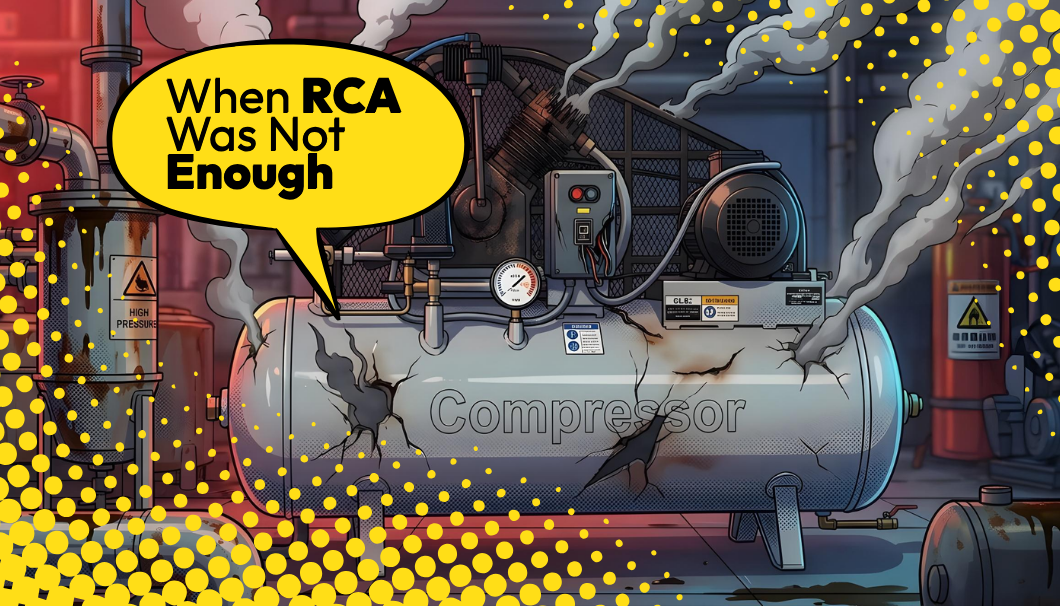
This article reviews a real case of repeated failures in a reciprocating compressor at a production facility. In this case, the RCA was not technically wrong, but it was not enough to completely eliminate the failures. The experience showed that some reliability problems go beyond maintenance activities and require attention to design limitations and actual operating conditions.
Equipment Overview and Operating Conditions
The equipment discussed in this case was a two-stage reciprocating compressor installed in the utility section of an oil separation facility. The compressor was used to supply instrument air and operated continuously, 24 hours a day.
This compressor was not only important for operation, but also for production continuity and process safety. ESD valves and several control systems at the site depended on the instrument air supplied by this compressor for proper operation. Because of this, any interruption in compressor performance could directly affect production stability and process safety.
Although a standby compressor was available, there was no automatic changeover system. As a result, every failure placed significant pressure on both the operations and maintenance teams. From an operational point of view, the reliability of this compressor had a direct impact on production continuity and safe plant operation.
The compressor maintenance program was based on the vendor’s recommendations. Air filters and lubrication oil were replaced at defined intervals, periodic inspections and condition monitoring activities were carried out, critical spare parts were available in stock, and the maintenance team had sufficient experience working with the equipment.
In addition, routine maintenance activities such as air filter replacement, oil change, intake system inspection, cooler cleaning, and auxiliary system checks were regularly planned and executed. Based on the initial review, there were no clear indications of problems in the maintenance program.
Beginning of Repeated Failures
The first failure occurred when the compressor seized and was removed from service for overhaul. The equipment was fully dismantled, machining work was performed on the shaft, consumable parts were changed, and after the required testing, the compressor was returned to service.
At that time, the failure was considered a normal operational event, and no additional action was taken.
However, after a short period of operation, the same failure occurred again.
Following the second failure, the PM interval was reduced, and air filter replacement and several maintenance activities were scheduled more frequently.
Despite these actions, a third failure occurred — this time after an even shorter operating period.
At this stage, it became clear that the issue was not simply a random equipment failure, but part of a larger underlying problem.
As the failures continued, pressure on both the operations and maintenance teams increased. Repeated failures reduced the operations team’s confidence in the reliability of the equipment, while the maintenance team had to repeatedly repair the same compressor without finding a lasting solution.
Attention then turned to the reliability team. The main question was why the problem continued despite PM activities, repair work, and repeated follow-up efforts.
As a result, the earlier approach was reconsidered, and a cross-functional RCA team was formed.
RCA Investigation and Technical Review
To investigate the problem, a cross-functional team from maintenance, operations, and engineering was formed. The team focused on understanding why the failures kept happening and what conditions were affecting compressor operation.
As part of the RCA review:
- Failure history records, especially MTBF and MTTR data, were reviewed
- Maintenance history was analyzed
- Actual operating conditions were evaluated
- And a structured RCA study was carried out
The main focus of the team was to understand why the failures continued even after repair work and PM activities had already been completed.
The RCA review showed that contamination in the compressor intake air allowed dust particles to enter the equipment, increasing wear and sensitivity of internal components.
It was also found that the dust level at the site was higher than the design capacity of the existing filtration system.
Initial Corrective Actions
Based on the RCA findings, several corrective actions were defined and implemented:
- Reducing the air filter replacement interval
- Improving inspection activities
- Revising maintenance procedures with more focus on dusty operating conditions
All corrective actions were updated and implemented through the CMMS, and the expectation was that the failures would stop.
However, in practice, the failures continued.
At this stage, two important questions were raised:
Was the RCA incorrect?
Or was the real problem beyond what the RCA had identified?
Understanding the Design Limitation
As the failures continued, the RCA team met again and carried out a deeper review of the actual site conditions.
Further evaluation showed that the main issue was not only related to maintenance activities, but also to a limitation in the filtration system design.
At this stage, the team started to look at the problem differently. It also became clear that the actual dust level at the site was significantly higher than the original design assumptions.
At the same time, the site operating conditions themselves had not changed significantly over the years. The increasing failure rate was mainly related to the growing sensitivity and wear of internal compressor components under the same dusty conditions.
The maintenance actions that had been implemented only reduced the frequency of failures, while the more fundamental issue — the insufficient design of the intake air system — still remained. At this stage, the team’s understanding of the problem started to change.
After identifying the design limitation, the findings were presented to senior management, and several engineering options were reviewed. In the end, a pre-filtration system was installed upstream of the main intake air filter to reduce incoming dust and prevent rapid saturation of the existing filter.
At this point, it became clear that the problem could not be solved by maintenance activities alone and required an engineering change.
Lessons Learned
1. RCA is essential, but not always sufficient
In many cases, RCA can identify the direct cause of failure. However, some problems are connected to deeper system limitations.
In such situations, focusing only on the initial cause of failure may not be enough to completely eliminate the problem. The questioning and analysis should continue until the full picture of the failure is understood.
2. Some reliability problems require engineering changes
Not all failures can be eliminated only by increasing maintenance activities.
In some cases, the main issue is related to design limitations or actual operating conditions, and long-term improvement may require engineering changes. One important lesson from this case is that organizations should not expect maintenance teams alone to solve every reliability problem.
3. Decision quality affects reliability improvement
Data and analysis alone do not improve reliability. The actions and decisions after the analysis are what improve reliability.
In this case, once the team moved from a maintenance-focused approach to a structural engineering solution, the compressor operating condition became more stable and predictable.
Conclusion
This case showed that even when corrective actions identified through the RCA are implemented correctly from a technical point of view, repeated failures may still continue.
In such situations, organizations should not treat these situations only as maintenance problems. Design limitations, actual operating conditions, and engineering decisions must also be considered as part of reliability improvement efforts.
In some cases, the main issue is not the quality of PM activities, but the conditions and design basis on which the system was originally built.
This experience also showed that failure analysis can improve reliability only when the findings lead to proper engineering decisions and effective engineering changes.
About the Author

Farshad Bakhshi is a Maintenance & Reliability consultant and CMMS implementation specialist with over 20 years of experience in asset-intensive industries. He helps organizations improve reliability performance through maintenance strategy, data governance, preventive maintenance optimization, and root cause analysis.