

A Reliability Leadership Institute® commentary on six decades of research into who gets seen, developed, and trusted with the work that keeps the world running.
By Terrence O'Hanlon, Creator, Uptime Elements Reliability Framework and Asset Management System
This article draws on and responds to “What 60 Years of Data Reveals About How Men and Women Experience Leadership” by Dwayne Whitten, Wendy R. Boswell, and Susan Oldroyd (Harvard Business Review, July 2026), reframed through the Uptime® Elements People and Culture at Work (PCW) domain for the rising reliability leader.
In 1965, Harvard Business Review asked a question it knew was provocative: “Are Women Executives People?” The provocation was the point. Of the 2,000 executives surveyed, a large share of the men viewed women in management unfavorably — not because they doubted a woman’s competence, but because they had decided the executive suite was no place for her. Every twenty years since, researchers have returned to that same instrument to measure whether the attitude had moved: in 1985’s “Compensation, Jobs, and Gender,” and again in 2006’s “What Men Think They Know About Executive Women.”
In 2026, three academics — one of them an author on the 2006 study — asked the questions again, adding new items on promotion criteria and perceived meritocracy to reflect a changed workplace. They gathered responses from 193 U.S. senior executives across industries, alongside qualitative interviews. What the data reveal is not the tidy story of steady progress we would like to tell ourselves. It is something stranger and more difficult: attitudes improved sharply on the surface between 1965 and 2006, and then the experience of women beneath that surface diverged from the experience of men.
A word before the numbers, because the numbers are easy to misread. Almost none of what follows describes bad faith. The vast majority of leaders in this field — women and men alike — are trying to be fair and believe that they are. The pattern the research documents is not malice. It is interpretation: the quiet, mostly unexamined habits that decide whose potential gets noticed, who gets coached, and whose record gets scrutinized. That distinction matters, because a problem of intent calls for blame, while a problem of interpretation calls for better systems — and better systems are something reliability leaders know how to build.
For those of us who lead in reliability, maintenance, and asset management, this is not someone else’s research. Ours is one of the most male-dominated professions on earth. The maintenance shop, the plant floor, the reliability engineering function — these have been, for generations, rooms where a woman was the exception. And the Uptime® Elements framework is unambiguous about what culture costs. Sixty-nine percent of reliability and asset management implementation failures trace not to equipment, but to people and culture. When a profession does not fully develop half of its available talent during a documented workforce shortage, that is not only a fairness question. It is a reliability question.
What the Numbers Actually Show
Two findings in the 2026 data stand out.
The first is experiential. Twenty years ago, men and women answered almost identically when asked whether women are judged more critically in senior roles — roughly 35 percent of each group agreed. Today men still sit at 35 percent. Women sit at 90 percent. In two decades, a shared perception split into two different readings of the same workplace.
The second is structural. In 2026, 83 percent of women reported they must be more exceptional than men to succeed, against 28 percent of men — a sharp move from 2006, when the figures were 68 and 32 percent. This is the pattern researchers call prove-it-again bias: the sense that a woman’s competence is presumed absent until demonstrated again, in a way men are less often asked to repeat. The data also point to a difference in what gets weighed. Men are more often advanced on potential; women more often on an established record. It is worth holding this as the experience the survey captured, measured largely through perception — but it is a striking and consistent perception, and perception is itself a cultural fact worth taking seriously.
The new items deepen the picture. Only 37 percent of women believe promotion criteria are applied equally across genders, against 70 percent of men. Only 40 percent of women believe their organization is a meritocracy, against 76 percent of men. One executive described the mechanism not as a disagreement about facts but as a difference in how the same system is lived. Men see a process applied consistently. Women report uneven access to the inputs that feed it — the visibility, the sponsor, the stretch assignment. Both may be describing the same organization accurately from where they stand.
Here the research meets something the People and Culture at Work passport names directly. Two of its six strategies are Matter at Work — ensuring people feel their contribution is seen and valued — and Worker Voice and Equity — ensuring every voice is heard and every worker is treated fairly. The 2026 data read as a measurement of both strategies under strain. When 90 percent of women feel judged more harshly and only 37 percent believe the rules apply equally, a workforce is telling you that its Worker Voice and Equity strategy is stronger on paper than in daily practice.
Merit, the research reminds us, is interpreted as much as it is measured. Studies of explicitly meritocratic organizations find a paradox: managers who most believe their system is fair can show more bias toward equally performing men, precisely because their confidence in the system switches off the impulse to double-check. Informal sponsorship flows along lines of familiarity that no formal policy fully reaches. None of this requires anyone to intend harm. It only requires a system that no one is auditing.
Why Progress Made It Harder to See
How does surface progress coexist with a widening gap in experience? The research points to two intertwined forces.
The first is polarization. Women leaders in the survey reported similar barriers regardless of the political leaning of their industry or region — so politics is neither the cause of the problem nor its cure. But polarization has turned a workplace question into a political one. When a real issue like uneven access gets fused to a politically charged solution, people stop discussing the issue and start arguing about the solution. The underlying barrier stays exactly where it was, now harder to talk about calmly.
The second is that much of what was built to help was thin to begin with. Many formal diversity programs fell short on their own terms — companies invested in visible signals, statements and policies, while leaving untouched the informal decisions that actually determined who advanced. When those programs were rolled back, the window dressing came off and the real decision patterns became more visible, not less. One executive described how, after her company paused its inclusion work for legal reasons, leaders spoke only of “performance” in promotion discussions — and people who had felt recognized as rising leaders began to wonder whether they were still being considered.
The downstream effect shows up in ambition. McKinsey’s 2025 Women in the Workplace report found, for the first time in its eleven-year history, a notable gap between men and women in the desire for promotion. The crucial detail cuts against a simple story: the gap disappears when women receive the same sponsorship and career support as men. Where the support is equal, the ambition is equal. That is an encouraging finding, because sponsorship is something an organization can choose to distribute more evenly.
What these forces share is a single shape — a distance between formal programs and the informal dynamics that formal policy never touches. Consider the CFO who had been fully vetted and approved to succeed her predecessor. Two months into the role, she was invited to a board dinner but not the board meeting that followed, so that directors who had already approved her could grow “comfortable.” No policy was broken. No one likely intended a slight. But the signal about whose authority still required a second look was there in the seating chart, invisible to any dashboard that only counts formal violations.
Here the Uptime® Elements framework offers hard-won precision. When the reliability community studied why its own implementation efforts fail, the breakdown was 35 percent lack of awareness and trust, 34 percent lack of leadership, 23 percent lack of competency, and 7 percent lack of empowerment. Read those numbers beside the leadership data and the resonance is worth noticing. Awareness, trust, leadership, and empowerment — the human factors that decide whether reliability takes root — are the same factors that decide whether talent of any kind is developed. The cultural work is one body of work, not two.
The Pipeline Question Is Structural, Not Attitudinal
matters that attitudes have genuinely improved since 1965. But favorable attitudes coexist with a structural bottleneck, and in our profession the bottleneck has a specific geography.
It has been measurably easier for a woman to advance in staff functions — HR, finance, legal — than in the operational roles where assets actually run. As of 2025, women held just 16 percent of COO positions, one of only two roles, alongside CFO, that executive-search data identify as the most common internal path to the top job. Much of women’s recent gain in the senior ranks came not from breaking into operational roles but from companies creating new support positions and hiring women into them — progress that cannot continue indefinitely, since no organization can add staff roles without end.
Pipeline data tell the same story. Men and women enter the workforce in roughly equal numbers, but a sorting begins at the very first step up to manager — the “broken rung” — and by the senior vice president level women hold only 31 percent of operational line roles. They end up concentrated away from the plant.
Two explanations sit on top of this pattern, and the honest reading is that both carry weight. The male executives in the study pointed to the real demands of operational roles and the flexibility that parents of young children — still disproportionately mothers — often need; that pressure is genuine and should not be waved away. The female executives pointed to something the first explanation leaves out: that the choice is often assumed rather than offered. As one put it, “We don’t ask the woman whether she is interested; we simply assume she is not.” The evidence suggests the assumption explains more of the gap than the flexibility alone does — research finds women as willing as men to accept international assignments and stretch roles, with the difference showing up in the consequences they face for taking the risk rather than in the willingness to take it. Both things are true at once: the demands are real, and so is the untested assumption. An organization that only credits the first will keep arriving at the same outcome without ever having asked the question.
Sponsorship compounds the sorting. Men are roughly three times more likely than women to be actively encouraged toward profit-and-loss responsibility, and nearly half of men receive detailed coaching toward P&L roles, against about 15 percent of women. When a woman does cross into an operational line function, evaluation can turn on subjective criteria: research finds that even when female line managers match or beat men on objective metrics, they can advance more slowly, because evaluators find it harder to picture them in senior operational command. The remedy here is not to accuse the evaluator. It is to make the criteria explicit enough that imagination is no longer doing the work.
The cost runs past any single career. Even when women are appointed to lead, they disproportionately inherit crises — the “glass cliff,” the documented tendency to hand non-traditional leaders the wheel of a firm already skidding. When those precarious appointments end badly, the failure is often attributed to the leader rather than to the crisis she was handed, and a traditional successor is installed. The stereotype is reinforced, the next appointment grows warier, and the cycle feeds itself. Naming the cycle is the first step to interrupting it — at both ends.
The Structure Already Being Built
Here the reliability community has something the broader research is still reaching for.
The People and Culture at Work passport names Community and Connection as one of its six foundational strategies — the deliberate building of belonging across teams, sites, and borders — because isolation is where talent quietly leaves. In this profession, that structure is not a proposal. It already exists.
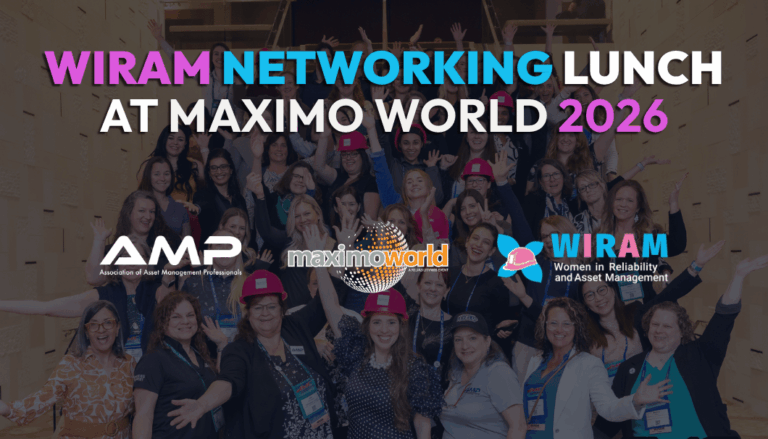
Under the leadership of Maura Abad, Executive Director of Women in Reliability and Asset Management (WIRAM), more than 1,600 women across the globe are already in the room together, working through the exact dynamics this research documents — the judgment gap, the prove-it-again tax, the missing sponsor, the operations track whose door is assumed shut rather than opened. WIRAM is not a statement of values. It is Worker Voice and Equity and Community and Connection operating in the same breath: a place where a woman in maintenance or reliability or asset management is heard, developed, and connected to peers who understand the floor she stands on. Where McKinsey’s data show the ambition gap closing the moment women receive real sponsorship, WIRAM is that sponsorship made structural — mentors and colleagues built into the profession rather than bolted onto it. And its value is not confined to the women in it; a field that develops all of its talent is a stronger field for everyone working in it.
In the language of the Uptime® Elements framework, WIRAM is a Trim Tab. A trim tab is the small surface that moves the rudder that turns the whole ship — the modest, well-placed intervention that shifts a system far larger than itself. You do not change a 60-year structural pattern with a statement. You change it the way you change anything in reliability culture: by finding the leverage point and applying steady pressure. A community of 1,600 women, growing, is leverage.
The Questions Worth Asking Now
Sixty years ago the question was whether women could lead. That question is answered. Twenty years ago the question was whether attitudes would change. They did, substantially. Today’s questions are harder and more precise: why did the gap in experience widen even as surface attitudes improved, and what does that tell reliability leaders about where the work still lives?
One executive who studied the pattern from inside his own organization offered the clearest formulation. The problem, he said, was not intent but interpretation. Merit had been defined too narrowly — as current performance — and in that narrow definition, trajectory and developmental potential disappeared. No policy was violated. Outcomes narrowed anyway. What changed his leadership was learning to ask not only “Who performed best?” but “Whose potential are we not yet seeing? Where is opportunity flowing, and why?”
Those are reliability questions. They are the same questions a good reliability leader asks about a failing asset: not only what broke, but what conditions made the break likely, and who saw it coming and was never asked. The Reliability Leadership Manifesto holds that our purpose is to make the world work for everyone, with no one left behind — and that “everyone” plainly includes the men who make up most of this workforce and are asked here not to feel guilty but to look more carefully. The tools for the redesign — defined criteria, structured documentation, real operational pipelines, honest feedback, and a community like WIRAM already carrying part of the load — are already in our hands. Sixty years of evidence make the conclusion plain. The barrier was rarely the tools. It was the willingness to pick them up and use them.
Who touches the assets that keep the world running? Who decides when they run and when they stop? Increasingly, and rightly, the answer includes a great many more women than this profession has yet fully developed. Developing them is not charity, and it is not a loss for anyone else. It is reliability leadership.
Reliability Leadership™, Uptime® Elements, and People and Culture at Work are trademarks of Reliability Leadership Institute LLC. This commentary engages research published by Dwayne Whitten, Wendy R. Boswell, and Susan Oldroyd in Harvard Business Review (July 2026); all survey figures and cited studies are drawn from that work and its referenced sources.
©2026 Reliability Leadership Institute® · www.reliabilityleadership.org